Evil eye tattoo meaning, ideas and designs
An evil eye tattoo is usually the nazar, the blue glass bead from Turkey and the eastern Mediterranean, drawn as four concentric rings.
- The Turkish name for the blue glass bead amulet is nazar boncuğu.
- The belief has local names including mati in Greek, ayn in Arabic, ayin hara in Hebrew and malocchio in Italian.
- A hamsa is an open hand, called the hand of Fatima or the hand of Miriam depending on the tradition.
- The Egyptian eye of Horus, the wedjat, is a separate motif and not a nazar.
- Pain level5 / 10 on the inner wrist
- Healing2 to 3 weeks on the surface
- Typical size3 to 8 cm (1 to 3 in)
- Studio cost$100 to $350

The nazar is a simple object and a hard tattoo. It is a dark blue outer ring, a white ring, a light blue ring and a black center, and all four need clean edges with clear separation. Freehanding a true circle is difficult, so most artists use a template or build it on the stencil, and anything under 3 cm loses the inner rings as the ink settles.
The second common version is an anatomical eye, drawn with iris striations, a catchlight and lashes. That is a different piece of work with a different failure mode. The catchlight is usually left as blank skin rather than put in with white ink, because white sits badly on most skin and yellows.
What the evil eye means and where it comes from
The belief is that a look, often an envious one, can cause harm, and that an amulet turns it back. It is old and widespread. Greek and Roman writers discuss it, protective eye motifs appear on ancient Mediterranean objects, and it is still an ordinary part of daily life in Turkey, Greece, the Levant, Iran, parts of South Asia and much of Latin America. Blue glass beads hang in cars, over doorways and pinned to babies' clothes.
The hamsa is the neighboring amulet, an open hand often with an eye set in the palm, called the hand of Fatima in Muslim contexts and the hand of Miriam in Jewish ones. People combine the two constantly. Two motifs get folded in by mistake: the Egyptian wedjat, the eye of Horus, is a different symbol from a different culture, and so is the Christian eye of providence inside a triangle.
The nazar, the hamsa and what to ask before you book
If the eye or the hand is religious to you or to your family, the question of whether to tattoo it at all belongs inside your own community rather than at a studio counter. Several mainstream Jewish and Islamic positions discourage or prohibit tattoos, and the people who can speak to that are a rabbi or an imam. A tattoo artist cannot, and this page cannot either.
If it is cultural rather than religious for you, the useful conversation is about which version you want. A flat nazar reads as a symbol, a glass bead with a highlight and a shadow reads as the object hanging in your grandmother's car, and an anatomical eye reads as an eye. Those are three different tattoos, and people describe all three with the same two words.
Versions people ask for
- Flat nazar, four concentric rings, usually 3 to 6 cm, the most legible option
- Glass bead nazar with a highlight and a cast shadow, so it reads as an object rather than a symbol
- Hamsa with an eye in the palm and ornamental linework around it, 6 to 12 cm
- Anatomical eye with iris striations and lashes, black and grey, 6 cm or more
- A single eye line with one lash, minimalist, which loses the protective reading for most viewers
Size, circles and the blue problem
Blue is the whole design, so ask about the ink. Blues hold better than yellows, but the pale inner ring is often a diluted blue, and diluted color fades toward grey faster than saturated color does. In the European Union, restrictions that took effect in January 2022 and January 2023 removed some widely used blue and green pigments from tattoo ink, so European studios have reformulated and can tell you what they use now. A black only nazar, built from line weight and solid fill, is the version that still reads in thirty years.
| Size | Result |
|---|---|
| 1.5 to 2 cm (under 1 in) | Rings merge, reads as a dark dot within a few years |
| 3 cm (1 in) | Four rings hold if the artist keeps clean separation |
| 5 to 6 cm (2 in) | Comfortable, with room for a highlight and a shadow |
| 8 to 12 cm (3 to 5 in) | Nazar inside a hamsa or an ornamental surround |
Placement, aging and the spots that fade
The common placements are the inner wrist, the back of the arm, the ankle, behind the ear and the back of the neck. Behind the ear and the nape are popular because the folk logic has the eye looking outward, back at whoever is looking at you, and that is the same reason people pick the back of the arm over the front.
Hands and fingers are where these go wrong. A 1.5 cm nazar on a finger is a blue smudge inside three years, because that skin turns over fast, takes constant abrasion and holds ink poorly. The inner wrist is better and still flexes, so keep it at 3 cm or more. Behind the ear is fine for a small one as long as the artist keeps the rings separated instead of fitting four of them into two centimeters.
12 evil eye tattoo designs, with the prompt behind each one
Every design below came out of AI Tattoo Lab. Tap one to load its prompt into the generator, then change a word and make it yours.
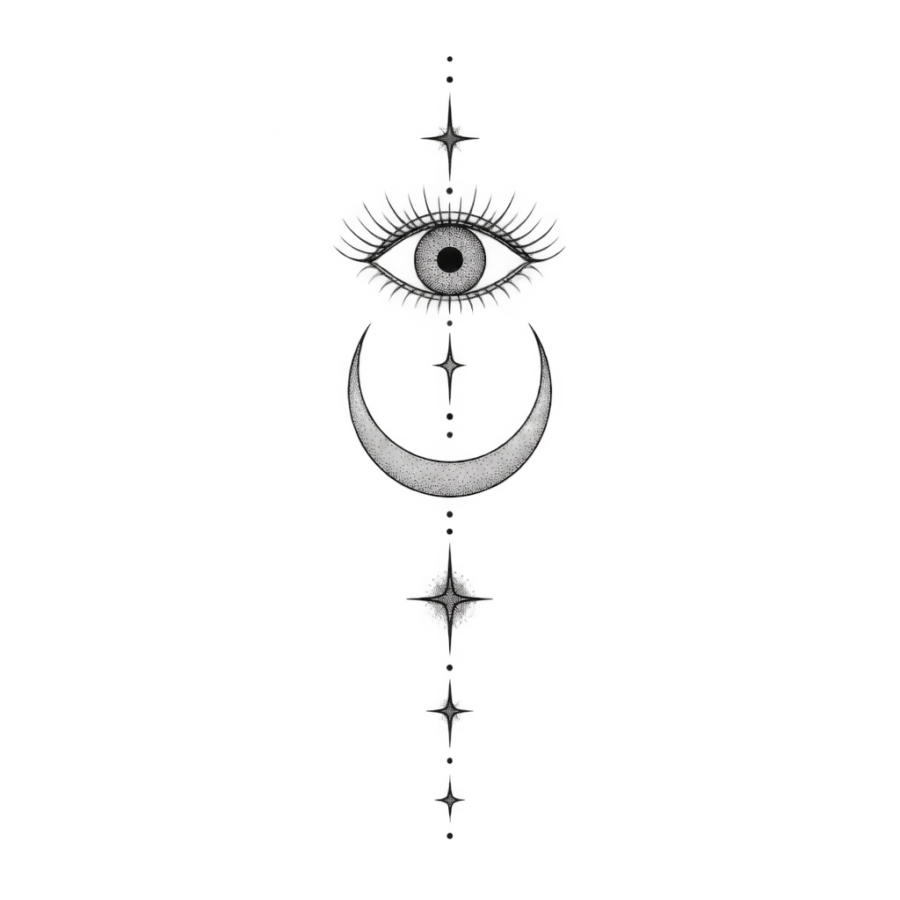
Evil eye with lashes over a crescent moon and small stars, fine line
Use this prompt
Evil eye in negative space inside a solid black circle, blackwork
Use this prompt
An eye inside a cresting Japanese wave with wind bars
Use this prompt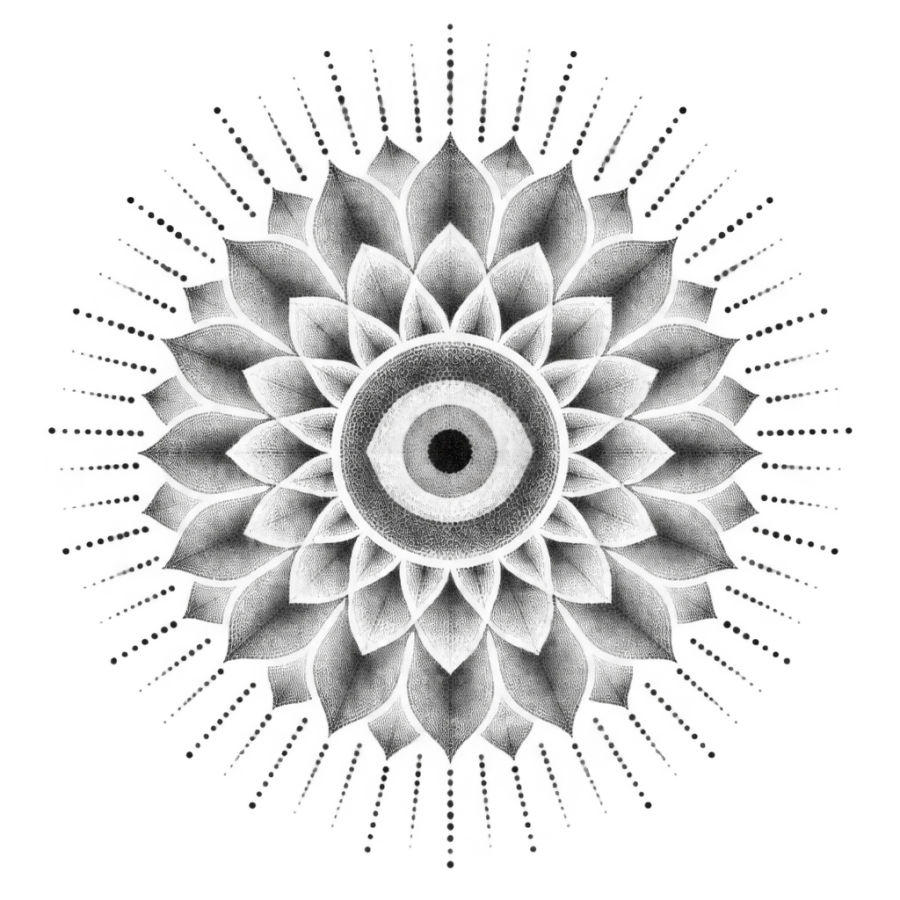
Evil eye at the center of a dotwork mandala with rays
Use this prompt
Geometric eye inside a hexagon with six radiating rays
Use this prompt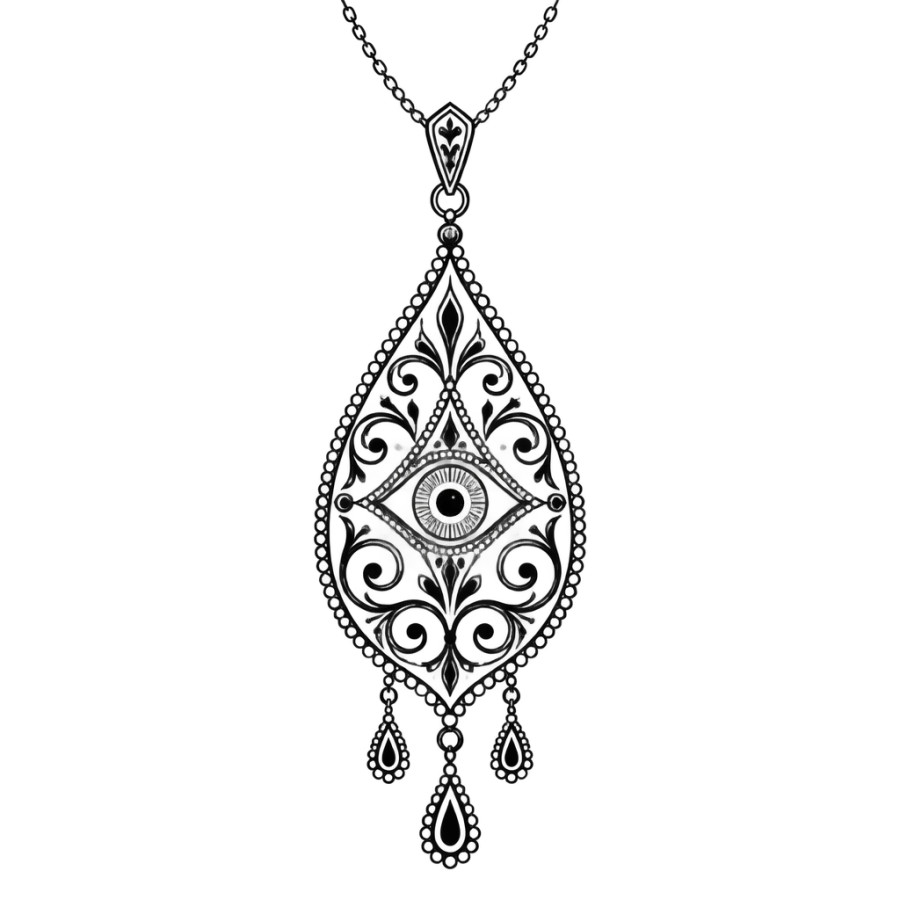
Evil eye teardrop pendant on a chain with lace filigree
Use this prompt
All seeing eye in a triangle with sunrays, woodcut hatching
Use this prompt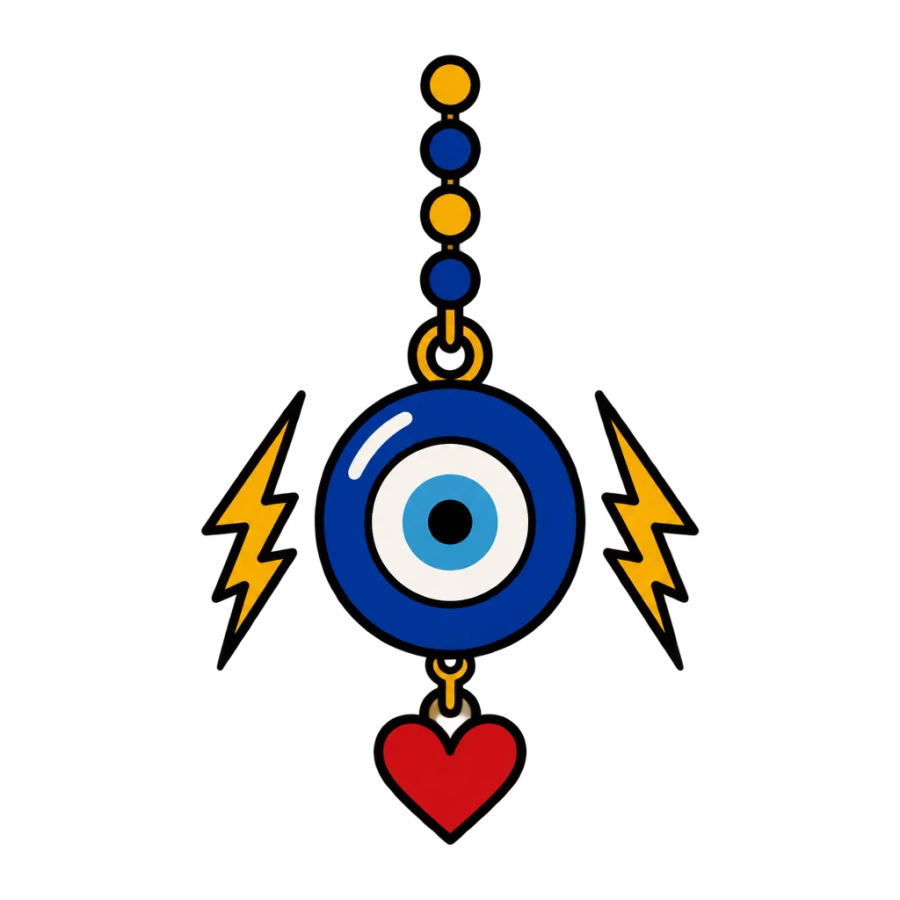
Nazar bead on a chain with lightning bolts and a heart
Use this prompt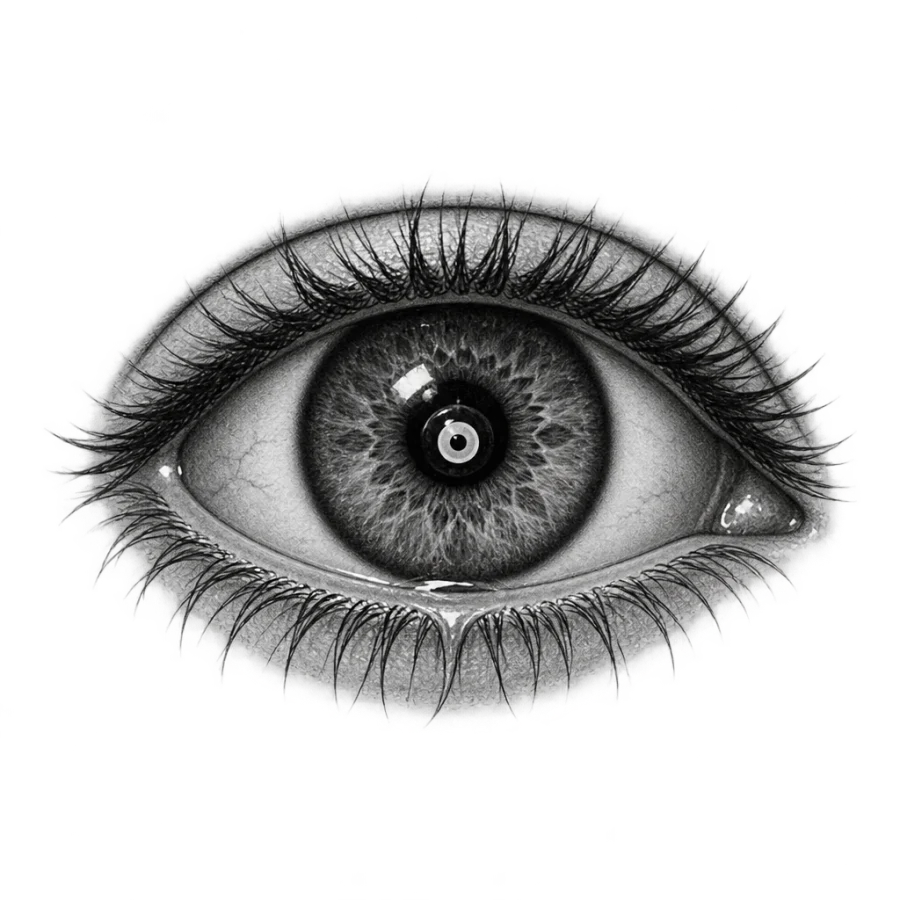
Realistic eye with a nazar bead reflected in the pupil
Use this prompt
Simple evil eye in one continuous line with a single lash
Use this prompt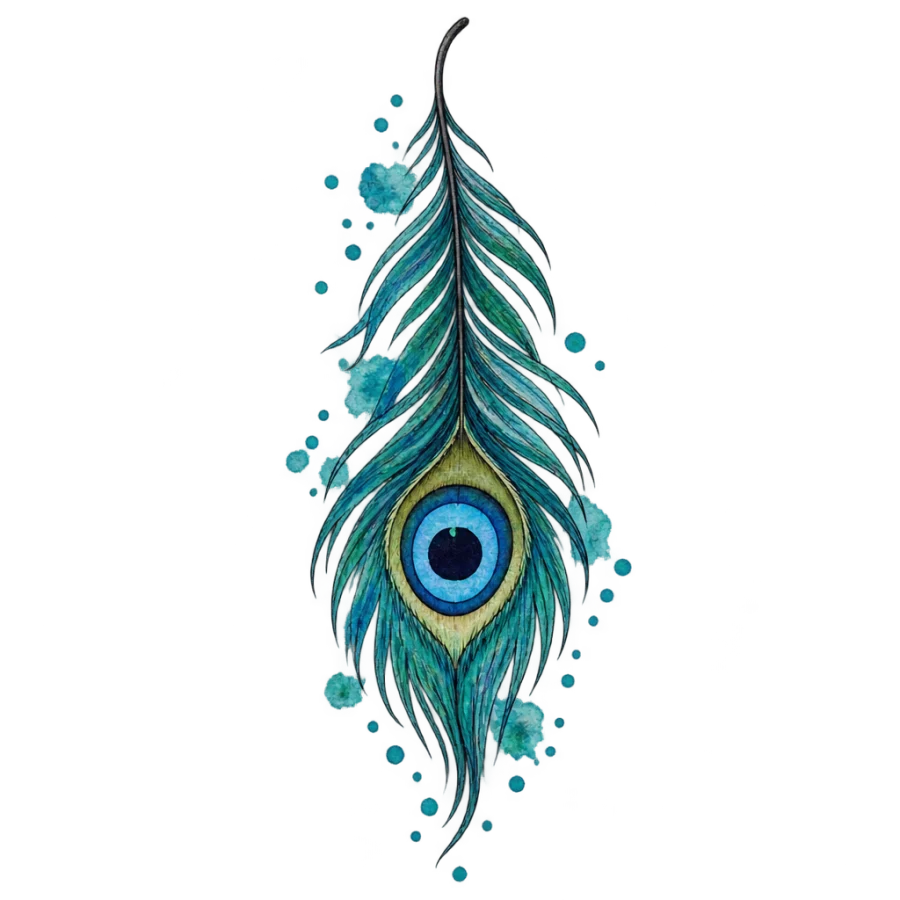
Peacock feather evil eye with loose teal watercolor splashes
Use this promptDescribe an idea of your own and get four designs back in about 20 seconds.
Open the generator
Questions people ask
What does an evil eye tattoo mean?
It is a protective motif. The belief that a look can cause harm is documented across the Mediterranean, the Middle East, South Asia and Latin America, and the blue glass bead, the nazar, is the amulet against it. Tattooing the bead means carrying the amulet. No one can tell you what the tattoo itself does.
Is it disrespectful to get an evil eye tattoo?
The nazar is a widely shared everyday object across Turkey, Greece, the Levant and beyond, and it is not a closed practice. The religious versions are different. If a hamsa or the eye is part of your faith or your family's, ask inside that community, since several Jewish and Islamic positions discourage tattoos altogether.
How small can an evil eye tattoo be?
About 3 cm if you want four separated rings. At 1.5 to 2 cm the rings merge and you end up with a dark blue dot within a few years. Fingers are the worst placement at any size. If you need something tiny, a black only two ring version holds better than a shrunken four ring one.
Where should an evil eye tattoo go?
The inner wrist, the back of the arm, the ankle, behind the ear and the nape are the usual spots, and several of them are chosen so the eye faces outward. Keep it off the fingers and the side of the hand, where abrasion and fast skin turnover will blur the rings within a few years.
Can I bring an AI evil eye design to a tattoo artist?
Yes, as a reference. Generate it, download the stencil, then take it to a licensed artist who will true up the circles, widen the ring separation so they do not merge, and tell you what blue they stock and how it behaves on your skin. The artist adapts the design to the spot you chose.