Tattoo outline stencils and line weight
A tattoo outline is the first and most permanent pass of the whole tattoo, because shading can be reworked later and a line can never be made thinner.
- Needle gauges: #08 is 0.25 mm, #10 is 0.30 mm, #12 is 0.35 mm.
- RL means round liner, and the number is how many needles sit in the grouping.
- A fresh 3RL line is roughly 0.5 mm wide and heals closer to 1 mm.
- Within a session the order is outline first, then shading, then colour.
- Stencil line on paper0.3 to 0.5 mm
- Fine line needle3RL at 0.30 mm
- Traditional outline9RL at 0.35 mm
- Spacing minimum1 mm, 2 mm on hands

The outline decides how the tattoo looks in twenty years. Pigment spreads sideways in the dermis at a slow steady rate, so every line you put down gets wider over time and never narrower. A 0.5 mm line heals at about 1 mm and keeps creeping. Shading can be added, lightened or covered. A line is the commitment.
That is why the stencil only holds lines. AI Tattoo Lab outputs black linework on a transparent background, which is the outline and nothing else, so what you print is what the liner follows. Line weight is the one thing worth settling with your artist before the needle starts.
What tattoo outline stencils are
The outline is the pass where the artist lays every contour of the design with a round liner, following the stencil, usually working from the furthest point back toward their own hand so they are never resting on wet line. It happens first because the line defines every edge the shading has to stay inside.
An outline drawing and a stencil are nearly the same object, with one difference. A drawing can keep construction marks, a soft second pass and tonal suggestion. A stencil keeps only what the needle will follow, so anything the artist is not going to tattoo comes out before it is printed.
Line weight and the needle that lays it
Line weight is a choice about how the piece will age as much as how it looks now. Thin lines read as delicate and spread into each other sooner. Thick lines read as graphic and stay legible far longer, which is most of why hundred year old traditional tattoos are still readable at a glance.
Hierarchy helps a piece read. A heavier outer contour with lighter interior lines separates the silhouette from the detail, which is how neo traditional work stays clear from across a room. Uniform weight on everything is a traditional choice and it works, as long as the design was drawn for it.
| Grouping | Gauge | Fresh line | Where it fits |
|---|---|---|---|
| 3RL | 0.30 mm | about 0.5 mm | Fine line, small script, interior detail |
| 5RL | 0.30 mm | about 0.8 mm | General outlining from 5 to 15 cm |
| 7RL | 0.35 mm | 1 to 1.5 mm | Neo traditional and bold botanicals |
| 9RL | 0.35 mm | 1.5 to 2 mm | American traditional outlines built to last |
| 14RL | 0.35 mm | 2.5 mm and up | Heavy blackwork and large Japanese line |
Cool tattoo outlines that stay readable
An outline that still looks good at ten years has a closed silhouette, clear negative space, and detail sitting at least 1 mm from its neighbour. The subjects that manage this tend to be the ones with a strong outer shape and a simple inside.
Outlines that hold their shape
- A snake in a single S curve, where the body width carries the drawing
- A moth or butterfly with four separated wing panels instead of twenty cells
- A hand of cards, a key, a dagger: hard edged objects with flat planes
- A wave crest drawn as three or four thick curves, Japanese style
- Script at 1.5 cm cap height or taller, with no decorative hairlines
Easy tattoo stencil outlines to start from
Start with an outline you can describe in one sentence. If the description needs a second clause for the interior detail, the design has more going on than a first stencil needs. A crescent and three stars, a single leaf, one bird in flight, a mountain ridge over a circle: each is four to ten lines and each reads at 4 cm.
Then size up once. Almost every easy outline improves at 20 percent larger, because the gaps widen and the needle gets room. That single change is what most often turns a mediocre small tattoo into a good one, and at the shop minimum it usually costs nothing extra.
12 outlines, with the prompt behind each one
Every design below came out of AI Tattoo Lab. Tap one to load its prompt into the generator, then change a word and make it yours.
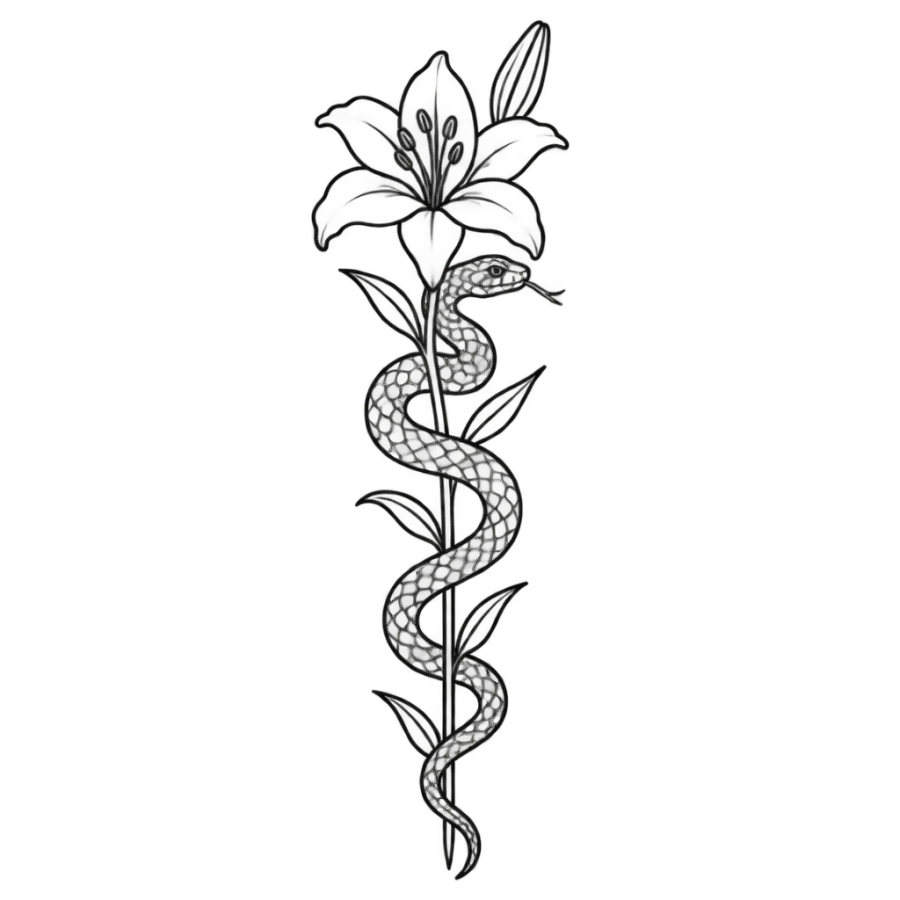
A snake coiled around a lily stem, outline only stencil
Use this prompt
A sun and crescent moon medallion drawn as pure outline
Use this prompt
Two swallows facing each other over a wheat sprig, outline only
Use this prompt
A mountain range with pines and a lake, clean stencil outline
Use this prompt
A sheet of six tiny symbols spaced apart, outline only
Use this prompt
A hot air balloon and clouds in an oval frame, outline only
Use this prompt
Two koi fish mirrored around a circle, pure stencil outline
Use this prompt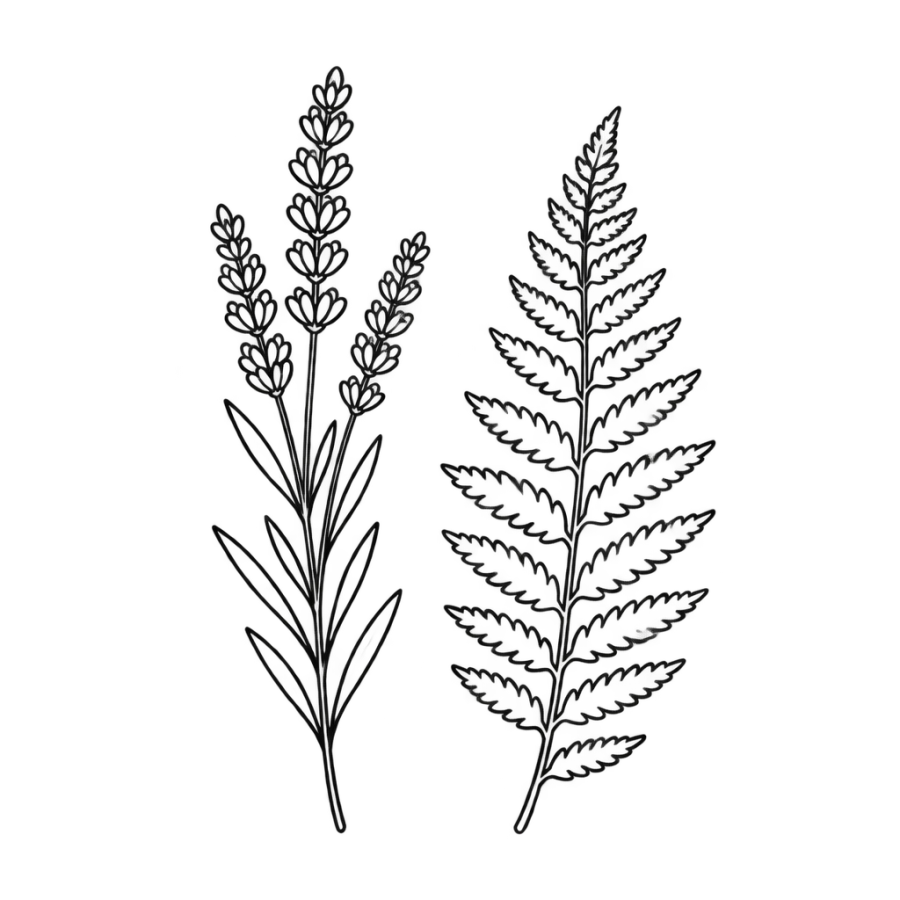
A lavender sprig beside a fern frond, clean outline plate
Use this prompt
A butterfly with wings spread, wing pattern as outline cells
Use this prompt
An anatomical heart with curling vines, loose outline sketch
Use this prompt
An owl perched front on, feathers as clean outline shapes
Use this promptDescribe an idea of your own and get four designs back in about 20 seconds.
Open the generator
Questions people ask
What is the difference between a tattoo outline and a tattoo stencil outline?
The outline is the tattooed line. The stencil outline is the transferred guide the artist follows to lay it. They match on purpose, which is why a stencil carries no shading. If the stencil holds a line, that line is getting tattooed, so anything you do not want permanently there comes out first.
What needle is used for a tattoo outline?
A round liner. A 3RL at 0.30 mm is common for fine line, 5RL for general outlining, 7RL to 9RL for bold and traditional work, and 14RL for heavy blackwork. The grouping number is how many needles sit in the cluster, and more needles means a wider line.
Does the outline of a tattoo get thicker over time?
Yes. Pigment migrates slightly in the dermis for the life of the tattoo, so a line widens and never narrows. A 0.5 mm fresh line heals around 1 mm and keeps creeping slowly. That is why lines closer than 1 mm merge, and why heavy traditional outlines stay readable for decades.
Can a tattoo be outline only?
Yes, and plenty of fine line and blackwork pieces are. Outline only work heals faster, costs less and ages predictably, since there is no grey wash to lighten. It can also be shaded later, which is a reasonable way to spread the cost across two sessions.
How thick should the line in my stencil be?
0.3 to 0.5 mm on the page, roughly 1 to 1.5 point at final size in a vector program. Thinner than 0.3 mm and the printer loses it. Thicker than 0.5 mm and the stencil stops telling the artist which weight you want, because the line itself becomes the shape.