Bible verse tattoo ideas and designs
A bible verse tattoo is a lettering problem before it is a design problem, and the decisions are translation, line breaks and letter size.
- Chapter and verse numbers were added to the text centuries after it was written, which is why reference formats differ between editions.
- The standard reference format is book, chapter, colon, verse: John 3:16.
- A verse range uses a hyphen, as in Proverbs 3:5-6. Separate verses are listed with commas.
- Most artists will not go below about 3 mm of lowercase x-height in script lettering.
- Philippians 4:13 is 57 characters in the King James and 51 in the New International Version.
- Pain level4 / 10 on the forearm
- Healing2 to 3 weeks on the surface
- Typical size10 to 25 cm of line
- Studio cost$120 to $500
Two people can get the same verse and end up with different tattoos, because translations word it differently. Philippians 4:13 in the King James runs "I can do all things through Christ which strengtheneth me". The New International Version has "I can do all this through him who gives me strength". That is 57 characters against 51, a different rhythm and a different weight on the pronoun, and it is a decision to make before anyone picks a font.
The rest of the job is mechanical, and mechanical is where these tattoos go wrong. How the reference is written, where the lines break, how tall the lowercase letters are, and whether anyone proofread it at final size. A misspelled tattoo is the hardest thing in this trade to fix, because you cannot erase a letter. You can only cover it or laser it.
Choose the translation before the font
Pick the wording you actually hear in your head, then count it. Translations run from formal and archaic to plain and modern, and the length moves with the style. A long formal rendering of a two verse passage can reach 180 characters, which at a readable size is three or four lines and about 15 cm of width, and that rules out several placements before you have chosen anything else.
If you grew up with a particular translation, use that one. The version read aloud in your family is the one you will hear when you look at your arm, and a wording that is not yours reads like a quotation from a stranger. If you are starting fresh, write the candidates out by hand and see which one you still like on the fourth reading.
Translations people usually choose between
- King James, formal and archaic, longer wording and the most recognizable cadence
- New King James, the same cadence with modernized spelling and pronouns
- New International Version, plain modern English and usually the shortest
- English Standard Version, close to the older wording but easier to read
- New Living Translation, the most conversational and the loosest
Reference format, line breaks and letter height
The reference can be written three ways and they look nothing alike. John 3:16 is compact and sits under a line of text like a signature. John chapter 3 verse 16 spelled out is longer and reads as part of the sentence. Or the verse text alone with no reference at all, which is what most people choose for long passages. Mixing formats across two tattoos is the thing people notice years later.
Line breaks go at clause boundaries. Break after a comma, after a conjunction, or where you would pause reading it aloud, and never in the middle of a prepositional phrase. Then set the lines so each is within about 20 percent of the others in length, because lines of wildly different widths look like an accident rather than a choice.
| x-height | A line of 50 characters | Holds up? |
|---|---|---|
| 2 mm | roughly 9 cm (3.5 in) | no, the counters fill in within five years |
| 3 mm | roughly 14 cm (5.5 in) | yes in a clean face, marginal in heavy script |
| 4 mm | roughly 18 cm (7 in) | yes in any style |
| 6 mm | roughly 27 cm (11 in) | yes, still legible at twenty years |
Proofreading, and why it is not optional
Print the text at final size. Not on a screen, on paper, at the exact dimensions it will be on your skin. Then read it backwards, word by word, from the last word to the first, because reading forwards your brain repairs errors without telling you. Check the reference numbers separately from the words, since chapter and verse get swapped more often than letters get misspelled.
Then have two other people check it, and make one of them someone who knows the verse. Once the stencil is on, read it in a mirror before the artist starts, and this time check the spacing between words rather than the spelling you have already checked four times. No artist will be annoyed by any of this. They have all tattooed something a client approved and then queried afterward.
The errors that actually happen
- A swapped chapter and verse, so 3:16 becomes 16:3
- A doubled or missing word at a line break, usually the word just before it
- Two different apostrophe shapes in one piece, one straight and one curly
- A capital letter the translation does not use, usually on a pronoun
- Letter spacing that closes up in one word and opens out in the next
Verses people ask for, placement and aging
The most requested references are short and about endurance: Philippians 4:13, Joshua 1:9, Jeremiah 29:11, Proverbs 3:5-6, Isaiah 41:10, Romans 8:28, 2 Timothy 1:7, Psalm 23:4 and Psalm 46:5. One thing worth knowing about that last one. The line that circulates as a tattoo, "God is within her, she will not fall", is the first half of the verse, and the New International Version continues "God will help her at break of day".
Lettering wants a long flat run. The outer or inner forearm along the length of the arm is the most readable placement and the most stable. The ribs photograph beautifully and are the worst choice for a long line, because the skin there stretches with every breath. Script ages by closing its counters, the enclosed spaces inside a, e and o, so an artist who draws those loops a little open on day one is doing you a favor.
12 bible verse tattoo designs, with the prompt behind each one
Every design below came out of AI Tattoo Lab. Tap one to load its prompt into the generator, then change a word and make it yours.

Be still in fine line script with Psalm 46 10 underneath
Use this prompt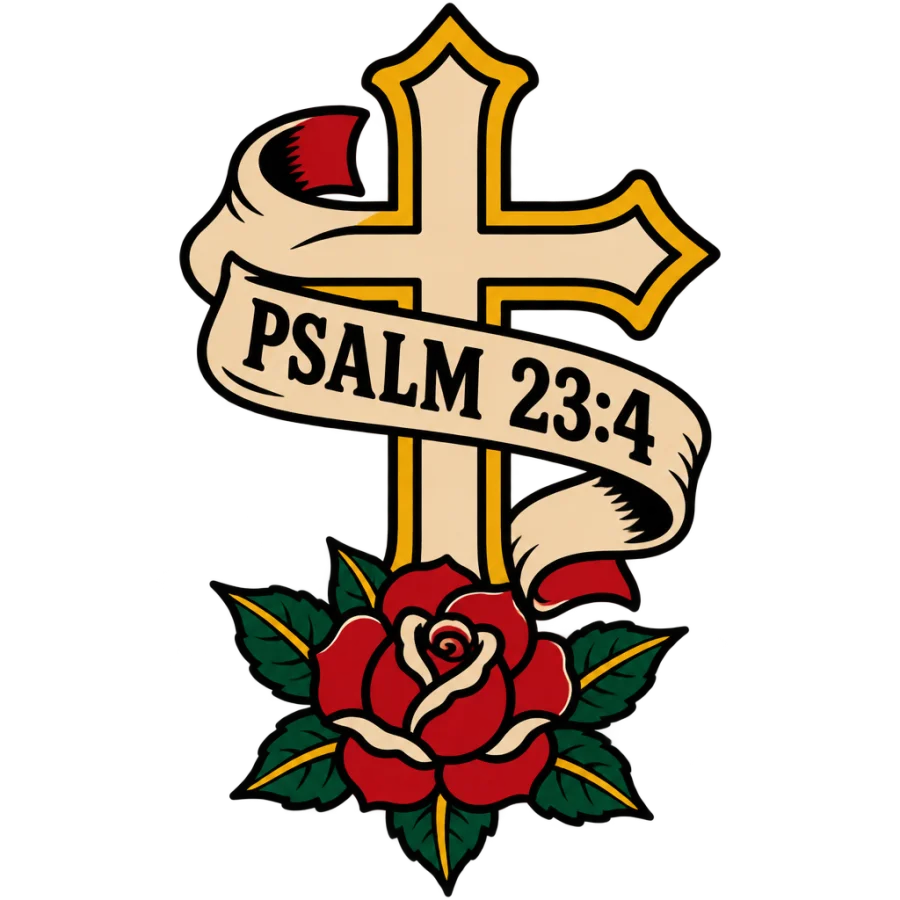
Traditional banner reading Psalm 23 4 across a cross with a rose
Use this prompt
Solid black cross with a dove in negative space and Isaiah 41 10
Use this prompt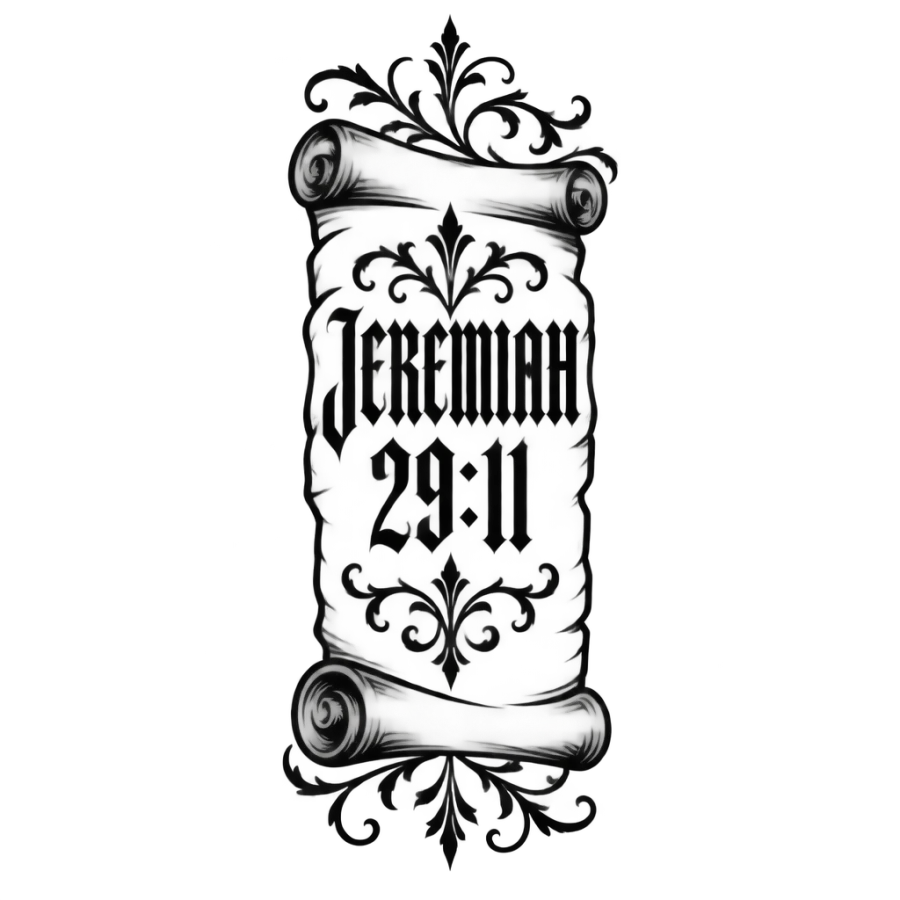
Jeremiah 29 11 in blackletter on an unrolled parchment scroll
Use this prompt
Phil 4 13 inside a radiant dotwork halo of light rays
Use this prompt
Geometric cross in a circle with Romans 8 28 lettered below
Use this prompt
Love is patient in script inside an ornamental lace heart frame
Use this prompt
Joshua 1 9 engraved on an open scroll between olive branches
Use this prompt
Tiny one line cross with Matthew 19 26 in typewriter capitals
Use this prompt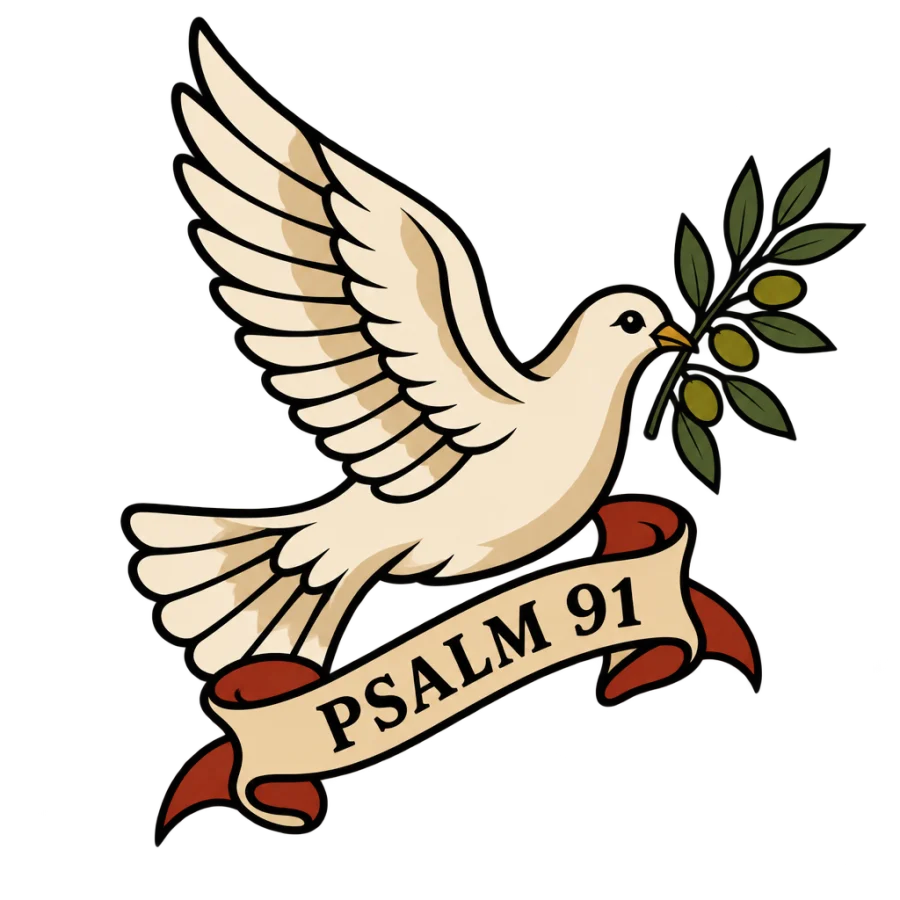
Dove with an olive branch above a ribbon reading Psalm 91
Use this prompt
Walk by faith in typewriter capitals over a small anchor
Use this promptDescribe an idea of your own and get four designs back in about 20 seconds.
Open the generator
Questions people ask
Which translation should I use for a bible verse tattoo?
The one you actually hear in your head, usually whatever was read aloud where you grew up. The King James is longer and more formal, the New International Version is the shortest and plainest, and the English Standard Version sits between them. Count the characters in each before you choose a font.
How small can bible verse lettering be?
About 3 mm of lowercase x-height in a clean typeface, and that is marginal in heavy script. At 2 mm the counters, the enclosed spaces inside a, e and o, fill in within five years and the line turns into a grey smear. A 50 character line at 3 mm runs roughly 14 cm wide.
Should I tattoo the verse or just the reference?
The reference alone is compact, stable at small sizes and legible only to people who know it, which many people prefer. The full text takes real width: 180 characters needs three or four lines and about 15 cm. Long passages are usually tattooed without a reference, since the words already identify themselves.
Where do bible verse tattoos look best?
Along the length of the forearm, which is flat, readable and one of the more stable areas for lettering. The upper back, the back of the arm and the collarbone all work. Ribs look good in photographs and spread fastest, because the skin stretches with every breath. Spine lettering reads vertically, which nobody finds comfortable.
Can I bring an AI bible verse design to a tattoo artist?
Use it for layout, never for the words. Image generators mangle text, inventing letters and dropping them, so treat the output as a guide to line breaks and lettering weight. Write the verse out yourself from a real bible, hand it to the artist, and proofread the stencil before any needle goes in.