Tattoo lettering and script ideas
Lettering is the one style where a mistake is unarguable: a misspelling or a closed up letter is visible to everyone who reads it, forever.
- Pain level4 / 10 on the forearm
- Healing2 to 3 weeks typically
- Typical size8 to 25 cm long
- Studio cost$100 to $600

Good tattoo lettering is typography done on a curved surface with a tool that spreads. Everything depends on three decisions made before the machine is switched on: the size of the letters, the space between them, and whether the line weight suits the place it is going. Font choice matters far less than any of those.
The styles in common use are script, blackletter, chicano lettering, roman serif capitals, typewriter, and reproduced handwriting. Each has its own rules. Script wants a flowing line along the limb, blackletter wants weight and room, and handwriting wants to be scanned at high resolution rather than traced from a phone photo.
The sizes that keep words readable
The holes inside letters, the counters in a, e, o, g and p, are what fail first. As lines spread over the years those gaps close and the word turns into a row of dark shapes. The practical minimum most letterers use is a 5 mm x height for script and 7 mm for anything with a heavier stroke such as blackletter.
Spacing follows from that. Letters need roughly one stroke width of clear skin between them, and lines of text need at least the height of a capital between baselines. A quote crammed into a 10 cm strip on the wrist will look elegant for two years and unreadable at twelve.
Proof it before the stencil goes on
- Read the text aloud twice, letter by letter, with the artist
- Check any translation with a native speaker, not an app
- Confirm punctuation, apostrophes and dates exactly as you want them
- Photograph the applied stencil and read it in a mirror
- Take five minutes alone with the stencil on before you agree to start
How each lettering style is tattooed
Script relies on weight variation. Artists usually pull the thin upstrokes with a 3RL and the thick downstrokes with a 7RL or by building a second pass over the first, which is what gives it the calligraphic swell. The long tails on the first and last letters are drawn last so they can be fitted to the body.
Blackletter and chicano lettering need more structure. The heavy stems are outlined with a 9RL and packed solid with a small magnum, and the fine hairlines are added afterwards with a 1RL. Reproduced handwriting is the opposite: a single consistent weight, usually a 3RL, traced faithfully including the wobbles that make it recognizable.
Following the body, not a straight line
Text laid perfectly straight across a curved limb looks bent. Letterers arc the baseline to follow the muscle, so a forearm quote curves gently along the bone and a collarbone word follows the line of the clavicle. Ribs are usually set at a slight diagonal because that is how the eye reads the torso.
Direction is a real decision too. Text running down the inner forearm reads correctly to you and upside down to everyone else. Spine lettering is read from behind and should run top to bottom. Decide who the tattoo is for before you decide which way it faces, because it cannot be changed later.
Ageing, placement and price
Lettering ages the way it was sized. Generous letters with open counters stay legible for decades and only look a little softer. Small, tight text goes first, and blackletter with hairline flourishes loses those flourishes while keeping the heavy stems, which usually still looks intentional. Script tails and thin connecting strokes are vulnerable too, so many letterers thicken them slightly beyond what the drawing calls for.
Inner forearm, outer forearm, collarbone, ribs, spine and the inner bicep all work well. A single word of 10 cm usually costs the shop minimum to $200. A full quote of two or three lines runs $250 to $600 and takes one to two hours, plus drawing time that many letterers charge for separately.
15 lettering and script tattoo designs, with the prompt behind each one
Every design below came out of AI Tattoo Lab. Tap one to load its prompt into the generator, then change a word and make it yours.

The words stay gold in flowing cursive script with a long sweeping flourish
Use this prompt
The roman numerals MMXIX in carved classical capitals framed by laurel leaves
Use this prompt
The single word resilience set in a vintage typewriter typeface, clean lettering
Use this prompt
The words carpe diem in flowing copperplate script with a long flourish
Use this prompt
The words hold fast in bold blackletter on two stacked lines
Use this prompt
The words ad astra in roman capitals with a small star above them
Use this prompt
The roman numeral MCMXCVIII in typewriter letters with a thin underline
Use this prompt
The words this too shall pass in fine line script on a gentle curve
Use this prompt
The words memento mori arched in blackletter above a small hourglass
Use this prompt
The words veni vidi vici stacked on three lines in roman capitals
Use this prompt
The words be here now in widely spaced typewriter letters, one line
Use this prompt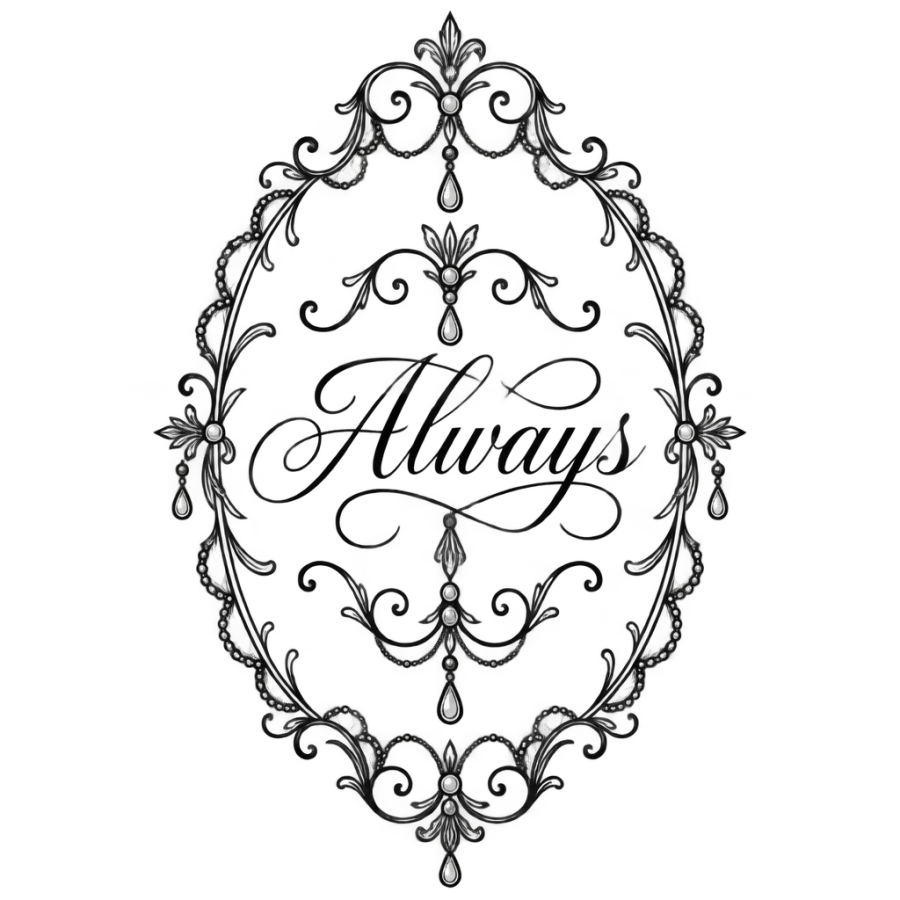
The word Always in script inside an oval filigree frame
Use this prompt
The word FEARLESS cut out of a solid black bar in capitals
Use this prompt
Dum spiro spero in one continuous cursive line with a flourish
Use this promptDescribe an idea of your own and get four designs back in about 20 seconds.
Open the generator
Questions people ask
How small can tattoo lettering be before it blurs?
Around 5 mm x height for script and 7 mm for heavier styles like blackletter. Below that, the counters inside a, e and o close up as lines spread, and the word becomes a row of dark marks within ten years. Longer quotes need more size, not smaller letters.
What font lasts longest as a tattoo?
Anything with open counters and even stroke weight, such as a clean serif or a simple script with generous loops. Very thin display fonts and dense blackletter at small sizes fail soonest. Size and spacing matter more than the typeface itself, so give the letters room before you choose a style.
How do I avoid a spelling mistake in my tattoo?
Read the stencil aloud letter by letter with your artist, check translations with a native speaker rather than a translation app, and photograph the applied stencil to read in a mirror. Take five minutes alone with it on before starting. Reputable artists expect this and will not rush you.
Which direction should a forearm quote face?
It depends who it is for. Text running down the inner forearm reads correctly to you and appears upside down to others. Text running along the outer forearm reads correctly to people facing you. Neither is wrong, but decide deliberately, since rotating the piece later is not possible.
How much does a quote tattoo cost?
A single word around 10 cm usually costs the shop minimum to $200. Two or three lines of text run $250 to $600 and take one to two hours. Custom drawn lettering often carries a separate design fee, because laying out the letters by hand takes real time before the session.