Peony tattoo ideas, meaning and designs
In Japanese tattooing the peony is the king of flowers, and the whole design rests on whether the ruffled petal layers stay separate as the ink settles.
- Pain level6 / 10 on the ribs
- Healing3 to 4 weeks on top
- Typical size10 to 25 cm (4 to 10 in)
- Studio cost$300 to $1,000
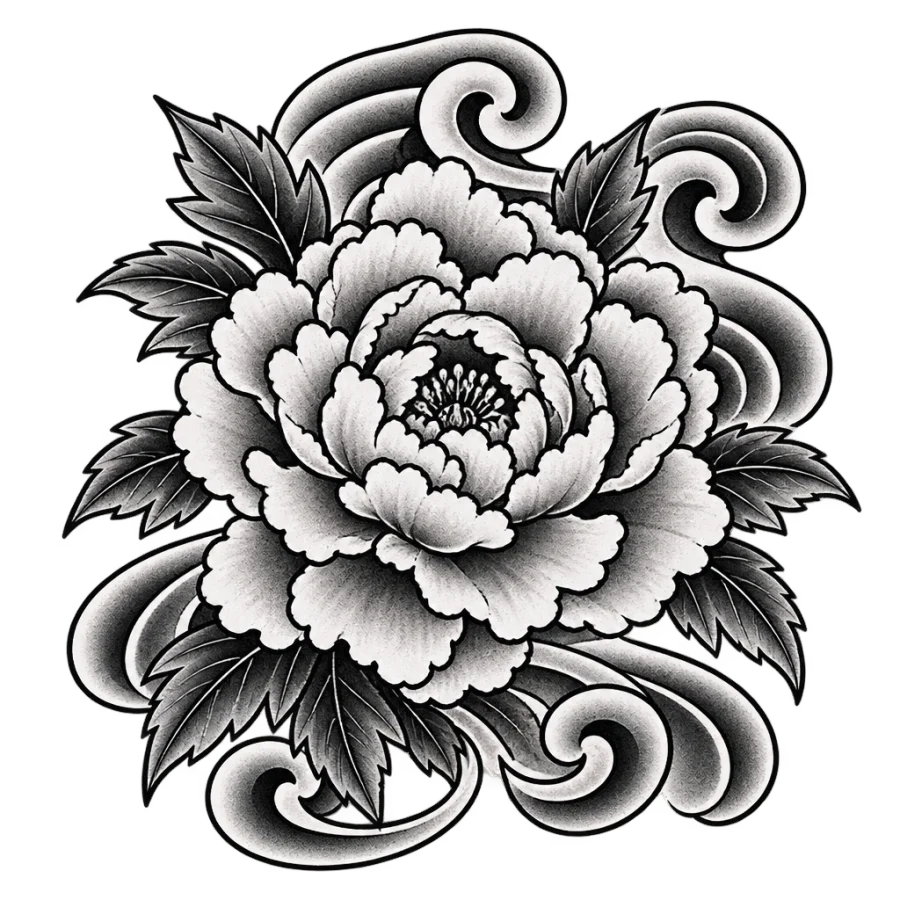
The peony reached Japan from Tang dynasty China, where it was already called the king of flowers and grown around Luoyang as a symbol of wealth and rank. Japanese tattooers took it up as botan, and it became one of the four or five plants that fill the space in a traditional bodysuit, alongside cherry blossom, chrysanthemum and maple.
Its classic partner is the shishi, the Chinese lion dog. Lion and peony is one of the oldest paired motifs in irezumi, borrowed from painting and woodblock prints, and the combination means something closer to nerve than to beauty. Where cherry blossom is about things ending, the peony is about holding your ground.
Why peonies need size
A peony is dozens of ruffled petals folded over each other around a dense center. All the drawing is in the overlaps, the small dark gaps where one petal sits behind another. Those gaps are where an artist puts black, and they are the first thing to close when ink spreads. A peony under 8 cm across turns into a round mass of soft grey within a few years.
Ten to fifteen centimeters per bloom is the working range for most styles. In a Japanese sleeve the flowers are usually larger still, 15 to 20 cm, because they have to hold their own against water, wind bars and a dragon. If you want something genuinely small, ask for a bud or a half open bloom instead, which has fewer petal layers to keep apart.
Size guidance by style
- Japanese traditional, 15 to 20 cm per bloom inside a larger composition
- Neo traditional, 10 to 14 cm with heavy outlines around each petal group
- Black and grey realism, 12 cm and up, with real black in the petal shadows
- Fine line, 8 cm minimum and only with a simplified petal count
How it is drawn in Japanese work
Traditional irezumi peonies have a firm outline around each petal, color packed flat inside, and a dark background of wind bars or finger waves behind the flower so the bloom sits forward. Pink and red are standard, sometimes white with grey shading for contrast within the same sleeve. Leaves are drawn as broad green shapes with a strong center vein, and the botany stops there.
The outline is doing the long term work. A Japanese peony at thirty years old has lost some color saturation but still reads as a peony because every petal has a black edge. That is the main argument for the traditional approach over a soft watercolor bloom, which can look extraordinary at one month and vague at eight years.
Placement and how it fits the body
A single peony is roughly circular, so it suits round or broad areas: the shoulder cap, the outer thigh, the chest, the back of the upper arm. On the ribs it works well tilted, following the line of the ribs. A cluster of two or three blooms with leaves makes a long shape that runs comfortably up a forearm or down a calf.
The ribs and sternum hurt more than people expect, usually 6 or 7 out of 10, and the skin there moves with every breath. A large peony in that area is easier in two shorter sessions than one long one. The outer thigh is the most forgiving spot for a first large floral piece and takes 20 to 25 cm without crowding.
Peony placements that work
- Shoulder cap, one bloom of 12 to 15 cm following the curve of the deltoid
- Outer thigh, two or three blooms with leaves at 20 to 25 cm overall
- Ribs, a single bloom angled to follow the rib line
- Forearm, a vertical cluster running from wrist toward elbow
Ageing and the mistakes people make
The two failures are scale and contrast. A peony drawn too small closes up in the middle, and a peony built only from mid greys and pale pinks loses its petal structure. Ask your artist where the darkest points are before they start. A good peony has real black somewhere, usually deep in the center and under the outermost petals.
Color choice matters over time too. Pink and red hold reasonably well with sun protection, while pale yellow and white lighten quickly and may effectively disappear on fair skin. If you want a white peony, expect the artist to build it from grey shading with the white left as bare skin rather than laid in white ink.
Variations that come up
- Peony and shishi lion together, the oldest pairing in Japanese work
- A single black and grey bloom with no background, for a clean standalone piece
- Peony with a snake coiled through the leaves, common in neo traditional
- Half open bud alongside a full bloom, which solves the small size problem
- A peony worked into a sleeve gap between a dragon and wind bars
12 peony tattoo designs, with the prompt behind each one
Every design below came out of AI Tattoo Lab. Tap one to load its prompt into the generator, then change a word and make it yours.
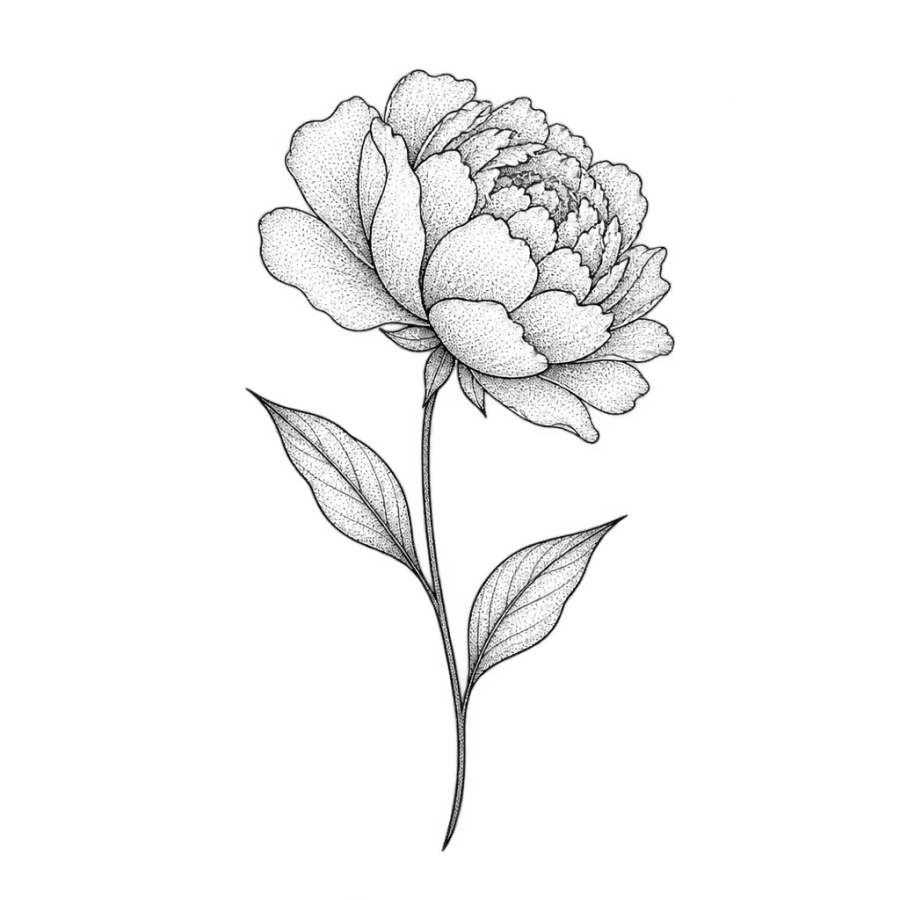
A single peony on a slender stem with two leaves, fine line
Use this prompt
A solid black peony with petal edges left white, heavy blackwork
Use this prompt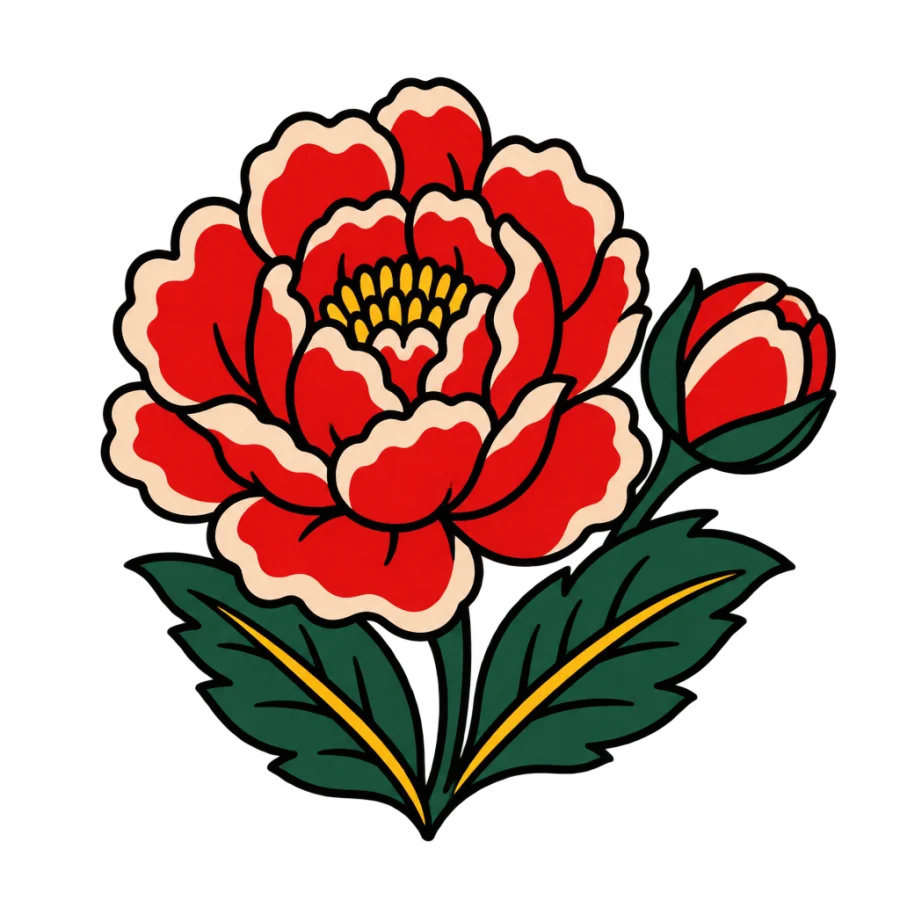
An open peony with a tight bud and thick leaves, American traditional
Use this prompt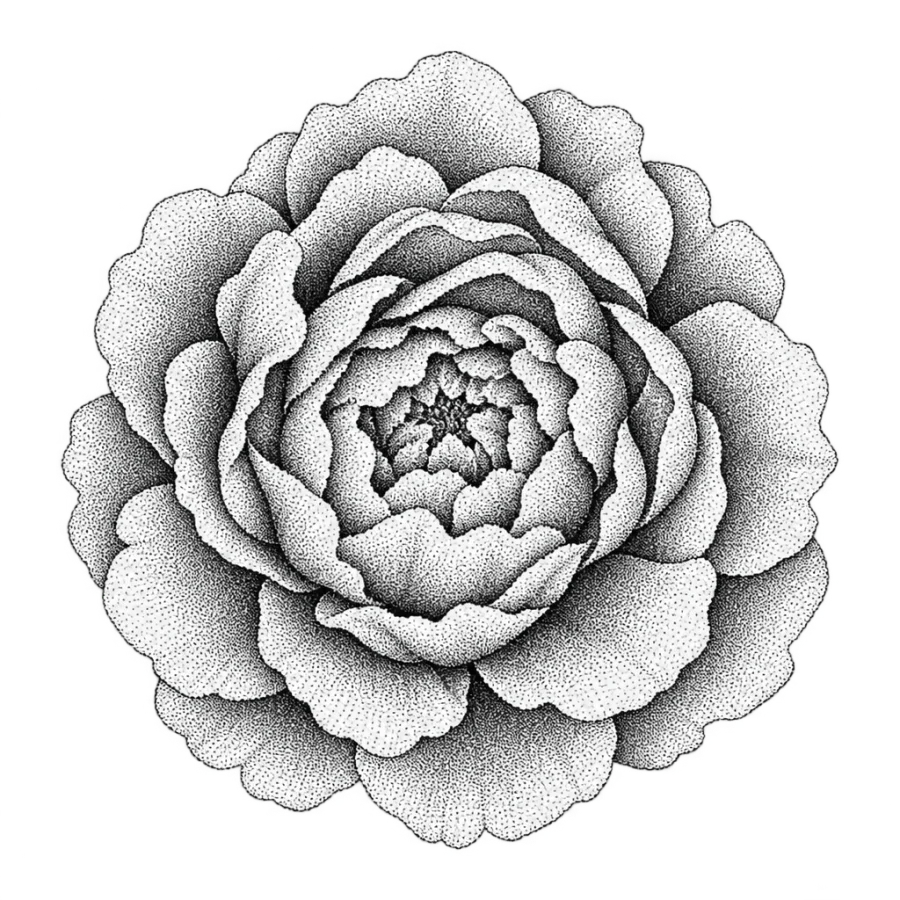
A peony seen from above with petals spiralling out, dotwork stippling
Use this prompt
A peony inside a hexagon frame with radiating lines, geometric line work
Use this prompt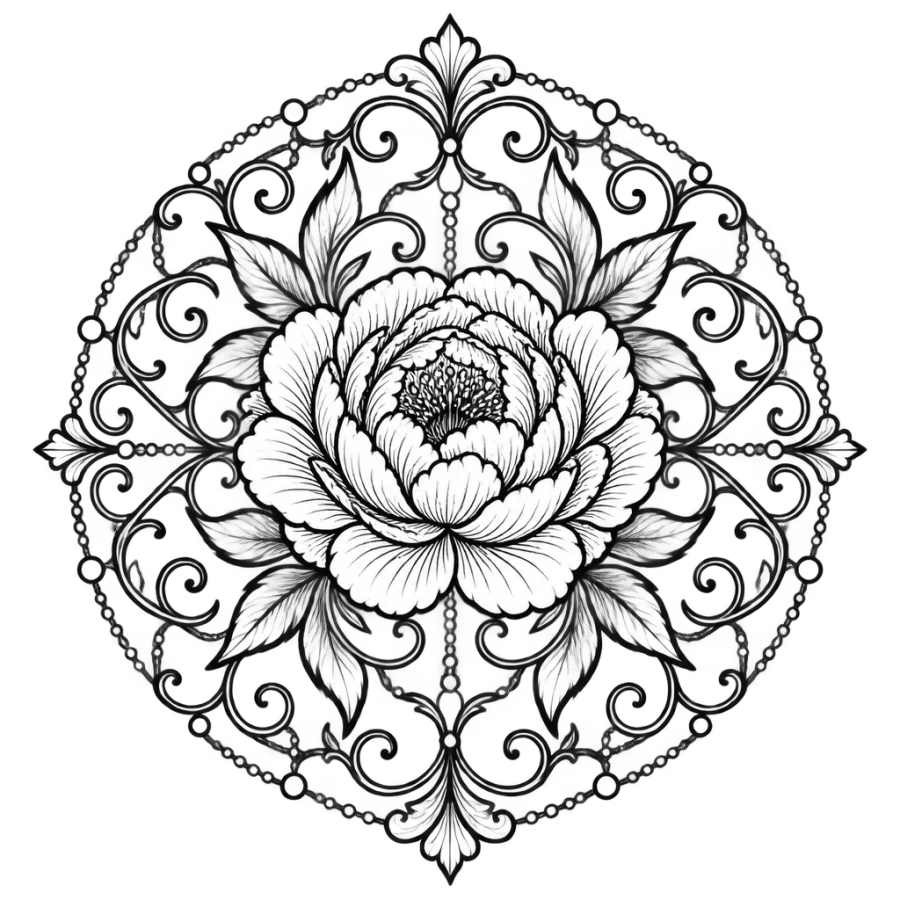
A peony medallion with leaves turning into lace scrolls, ornamental filigree
Use this prompt
A peony flower and one leaf drawn in a single continuous line
Use this prompt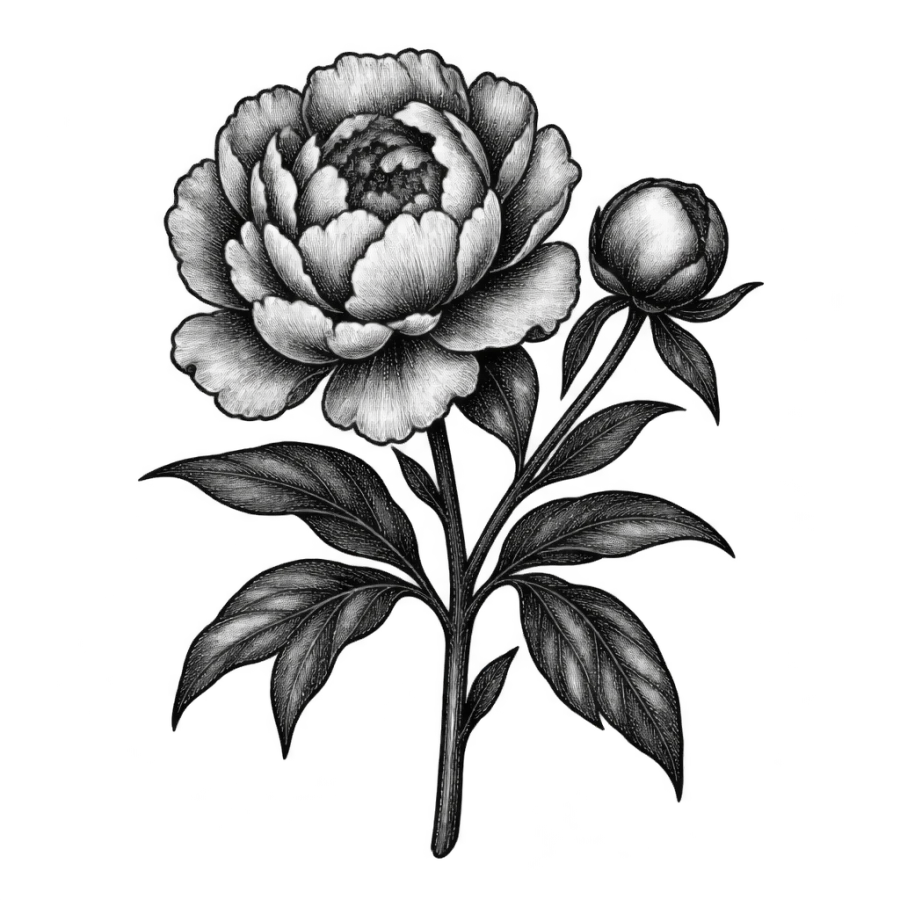
A botanical peony with an open bloom and a closed bud, engraving style
Use this prompt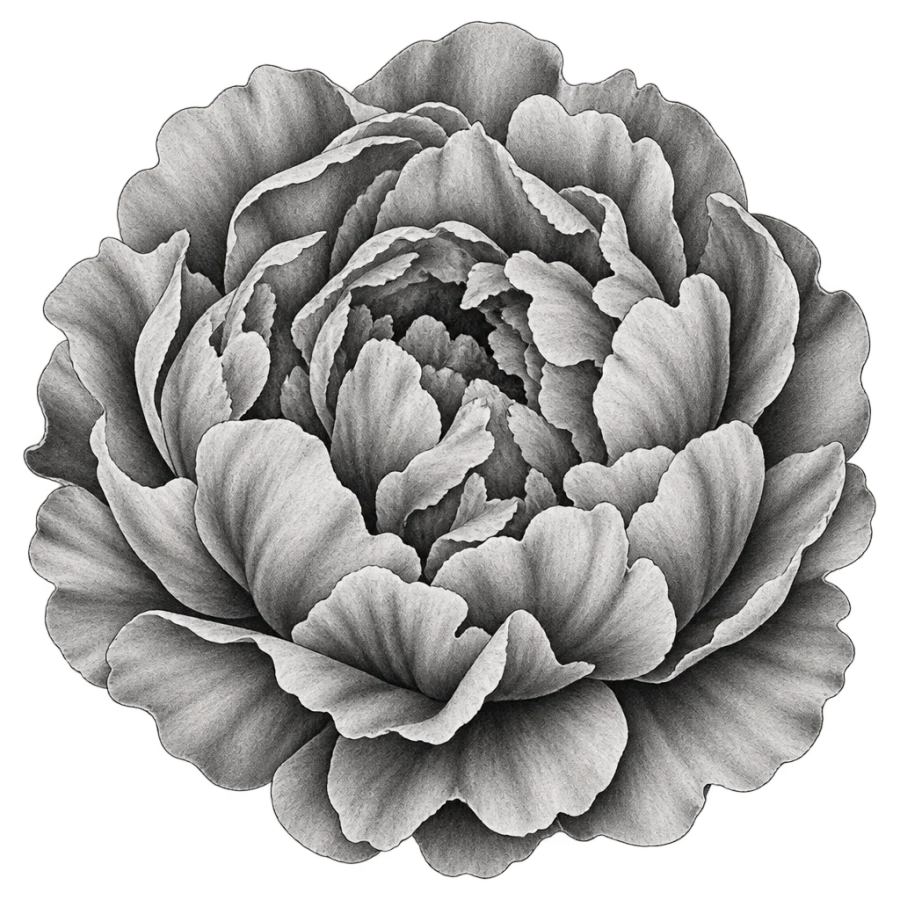
A close up of layered peony petals, black and grey realism
Use this prompt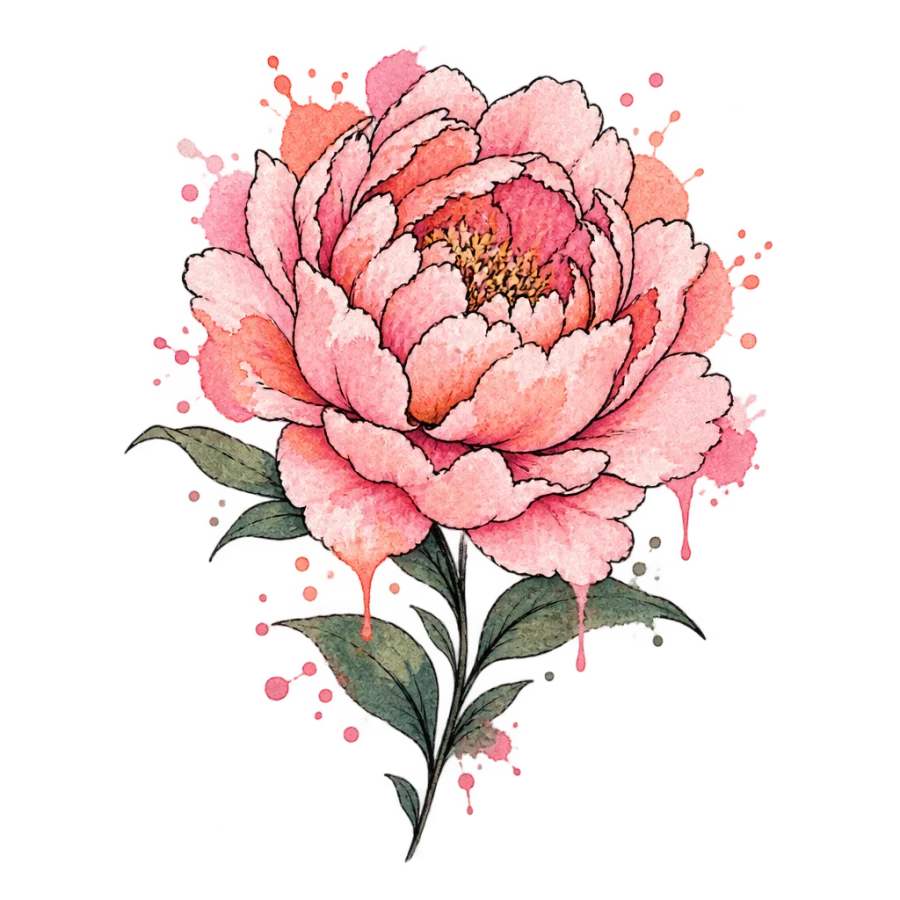
A peony with pink and coral washes spreading past the petals, watercolor
Use this prompt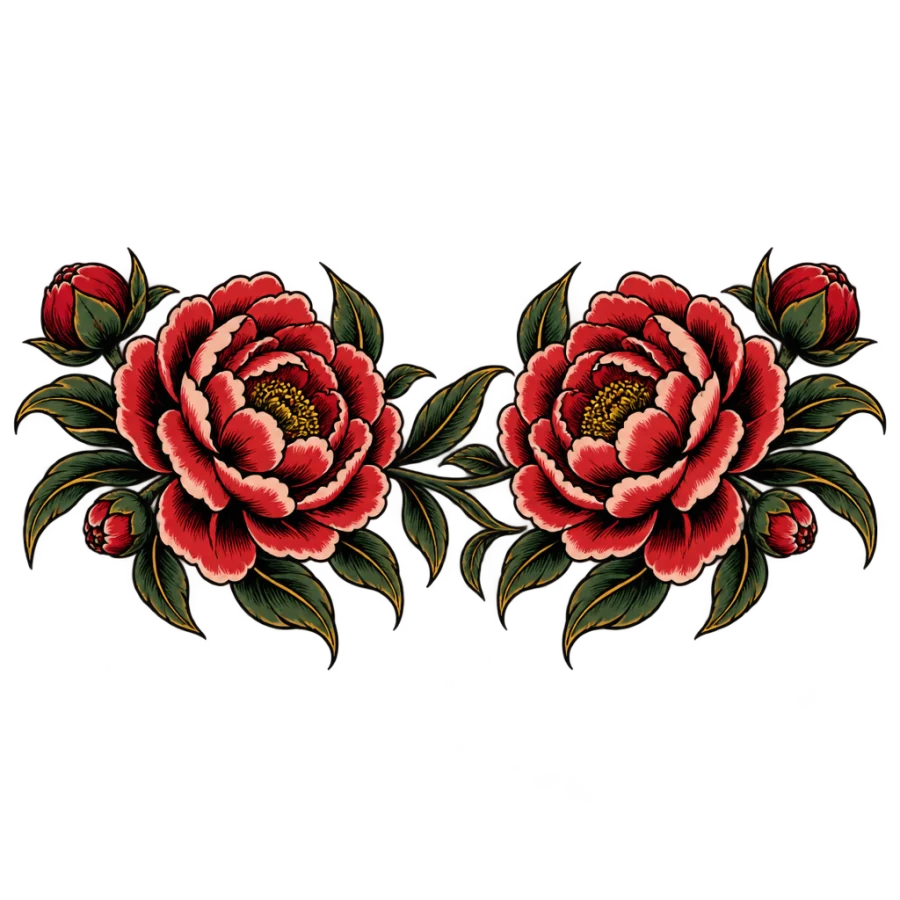
Two facing peony blooms with buds and trailing leaves, neo traditional
Use this promptDescribe an idea of your own and get four designs back in about 20 seconds.
Open the generator
Questions people ask
What does a peony tattoo mean?
In Japanese tattooing it means bravery and good fortune, and it is paired with the lion for that reason. The meaning came from China, where the peony was the flower of wealth and honor and was known as the king of flowers. Outside that tradition, most people choose it for the shape.
How big should a peony tattoo be?
Ten to fifteen centimeters per bloom for most styles, and 15 to 20 cm inside a Japanese sleeve. The petal overlaps are what make it read as a peony, and below about 8 cm those overlaps close into a grey mass. A bud or half open bloom works better if you need something small.
What is the difference between a peony and a rose tattoo?
A rose is a tight spiral of petals around a closed center. A peony is broader and flatter, with ruffled petal edges and a looser open middle that shows stamens. Roses read clearly at 5 cm. Peonies need roughly twice that because their structure lives in the layering.
Do peony tattoos age well?
Japanese and neo traditional peonies age well because every petal has a black outline holding it. Soft watercolor and pale color versions lose their structure faster, often within eight years. Ask your artist to include genuine black in the center and under the outer petals whichever style you pick.
How much does a peony tattoo cost?
A single 12 cm bloom in black and grey is usually $300 to $550 and takes two to four hours. A color peony in traditional Japanese style with background runs $600 to $1,000. Multiple blooms on a thigh or a full sleeve panel are quoted by the session, commonly $600 to $900 a day.