Rose tattoo ideas, meaning and designs
A traditional rose is one of the very few tattoos that still looks correct at thirty years old, which is why artists keep drawing the same one.
- Pain level5 / 10 on the upper arm
- Healing2 to 3 weeks on the surface
- Typical size7 to 20 cm (3 to 8 in)
- Studio cost$150 to $900

The tattoo rose is shorthand, drawn roughly the same way since the 1930s: a spiral bud at the center, five or six outer petals folded around it, two or three leaves, the whole thing inside a heavy black outline. It reads from across a room, and it still reads from across a room at thirty years, because the black line has somewhere to spread into.
Realistic roses are a different job. A grey wash rose depends on the range between the brightest petal edge and the darkest fold, and that range narrows as the tattoo ages. Fine line roses depend on interior petal lines that sit close together, which is the first thing to close up. Both look better at 12 cm than at 6 cm.
Where the tattoo rose comes from
The rose arrived in Western tattooing through military and maritime work in the first half of the twentieth century. Sailor Jerry Collins and his contemporaries drew it as filler and as a carrier for a name, because a rose with a banner underneath said something about a person without needing a portrait. The Rose of No Man's Land, a red rose with a nurse's face inside it, comes from a 1918 song about front line nurses and is still tattooed today.
The rose and dagger is the other inherited design. A blade through a rose is usually read as love that cost something, or as betrayal, and it has no single documented origin. Using a bouquet where each bud stands for a family member is a modern habit, and a good one, because it gives an artist a reason to vary the flowers.
How a rose is actually built
Most artists start the rose from the center and work out. The bud is drawn as a spiral, and the first ring of petals wraps it asymmetrically so the flower has a front and a back. Outer petals curl away from the viewer with the tip folding over, which is the detail that makes a rose look like a rose rather than a cabbage. Leaves come last and fill awkward gaps in the composition.
In American traditional the outline is pulled with a 7RL or 9RL, the petals are packed in two or three values of red, and black is used only in the deepest folds. In black and grey the outline is much lighter, often a 3RL, and the shape is carried by wash. Neo traditional keeps the heavy line but adds petal count, a wider palette and harder edged highlights.
Style by style, what changes
- American traditional uses a bold outline and about six petals, and it is the version that ages best
- Neo traditional doubles the petal count and adds a cool highlight on each fold
- Black and grey realism needs a real photo reference and 12 cm or more to hold the tonal range
- Fine line draws the petal edges only, with no fill, and wants generous spacing between folds
- Blackwork treats the rose as a silhouette with the petal separations cut out in negative space
Size, cost and how it ages
A traditional rose works down to about 5 cm because the design has few internal lines and each one is heavy. Realism has a hard floor closer to 10 or 12 cm, since the grey range collapses when the tones sit too close together. Fine line roses below 7 cm tend to turn into a grey knot within five years as the interior petal lines migrate toward each other.
Expect a shop minimum of $100 to $150 for a small traditional rose, $250 to $450 for a 12 cm one with color, and $600 to $1,200 for a realistic forearm piece that takes two sessions. Bold roses age the best of almost any tattoo subject. At twenty years a well packed traditional rose has softened and warmed, and it still reads as a rose.
Placement, and the roses people regret
A rose is roughly circular, which makes it forgiving. It fits the shoulder cap, the outer bicep, the front of the thigh, the sternum and the hip. Artists use roses constantly as connective filler in sleeves, because a rose can be stretched, tilted or partly hidden behind another element without looking wrong. A single rose on a flat area with nothing around it is the version that most often gets covered later.
The regrets are predictable. Tiny realistic roses on the wrist and the fingers blur. Very light grey roses, the kind that look airy in a healed photo taken the same week, can drop to almost nothing in three years and need a rescue session. Adding a partner's name under the flower is the other one, and artists will usually tell you to leave the banner empty or put a date there instead.
Questions worth asking at the consultation
- Can I see a healed photo of a rose you tattooed at least three years ago
- Is this design going to hold at the size I am asking for
- Does the grey in this need to be darker to survive a decade
- Should the banner stay empty so I can add to it later
- How does this rose sit if I extend the piece into a half sleeve
12 rose tattoo designs, with the prompt behind each one
Every design below came out of AI Tattoo Lab. Tap one to load its prompt into the generator, then change a word and make it yours.
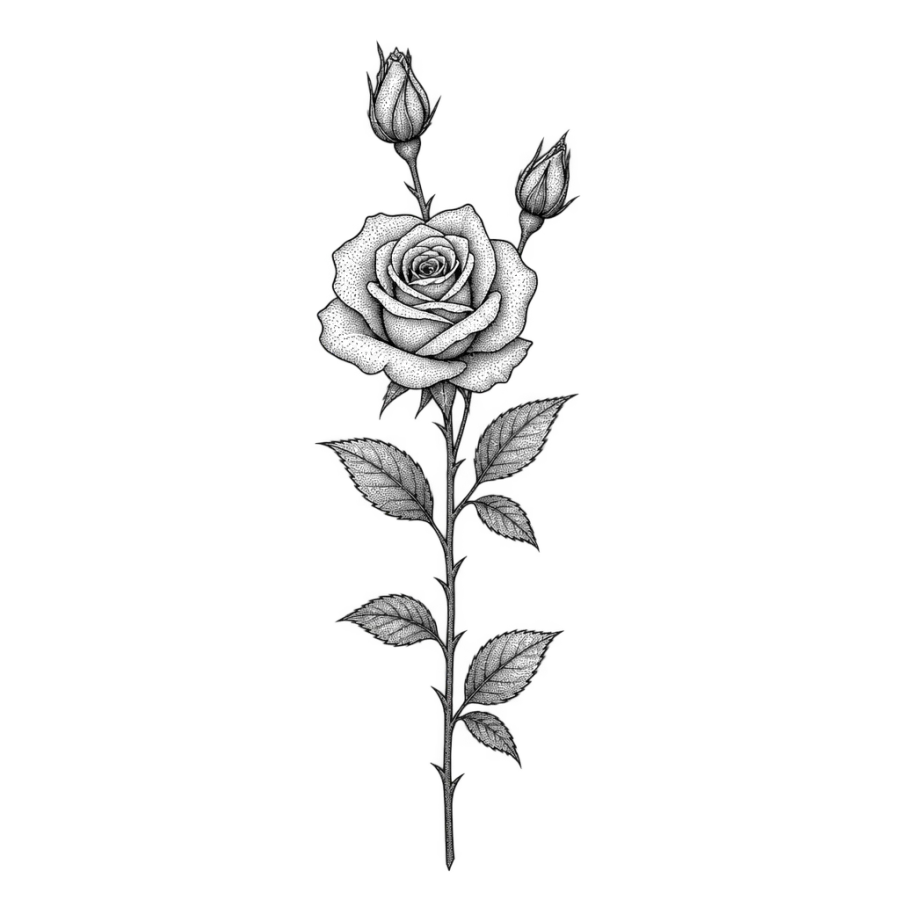
Rose tattoo design
Use this prompt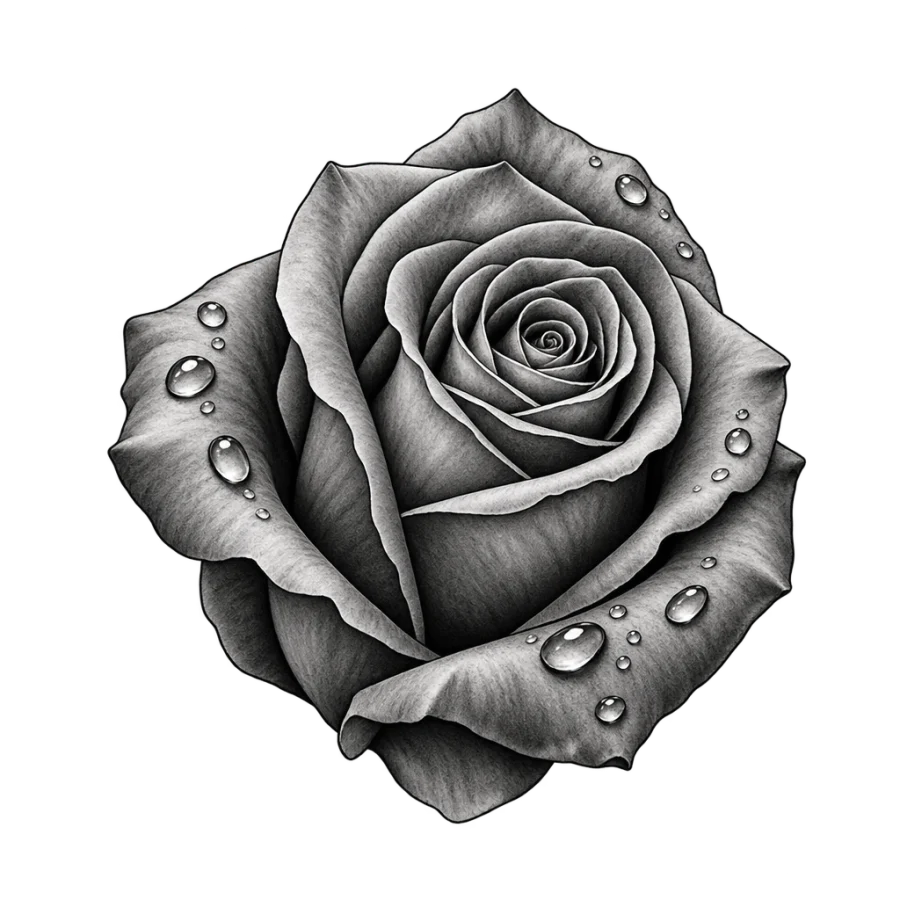
Rose tattoo design
Use this prompt
Rose tattoo design
Use this prompt
Rose tattoo design
Use this prompt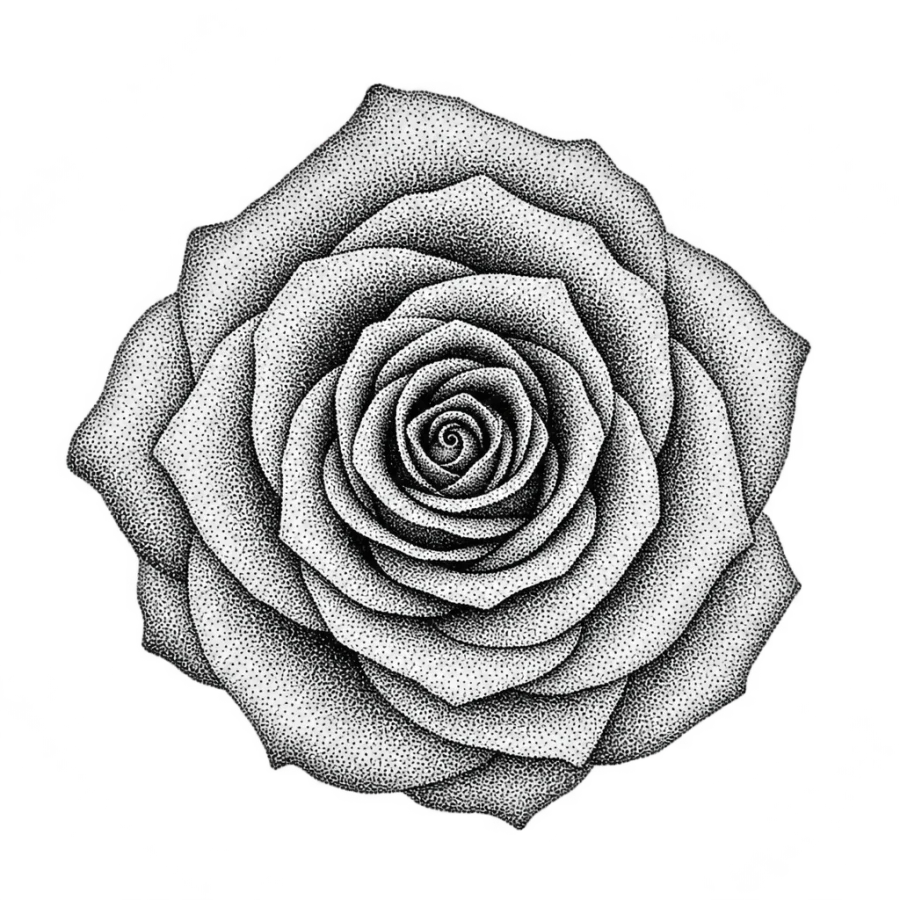
Rose tattoo design
Use this prompt
Rose tattoo design
Use this prompt
Rose tattoo design
Use this prompt
Rose tattoo design
Use this prompt
Rose tattoo design
Use this prompt
Rose tattoo design
Use this prompt
Rose tattoo design
Use this promptDescribe an idea of your own and get four designs back in about 20 seconds.
Open the generator
Questions people ask
What does a rose tattoo mean?
Love, most of the time. The color readings people quote come from Victorian flower dictionaries published in the 1800s, with red for love and white for purity being the two that survived. A black rose usually marks grief or a death, though often it is simply the monochrome version.
How big does a rose tattoo need to be?
About 5 cm for a bold traditional rose, since it has few internal lines. Realistic grey wash roses need 10 to 12 cm before the tonal range holds, and fine line roses want at least 7 cm so the petal folds stay separate as they spread over the years.
How much does a rose tattoo cost?
Around $100 to $150 at shop minimum for a small traditional rose, $250 to $450 for a 12 cm color piece, and $600 to $1,200 for a realistic forearm rose across two sessions. Named artists in large cities charge well above this and book months ahead.
Do rose tattoos age well?
Traditional ones age better than almost any other subject, because heavy outlines have room to spread before they look wrong. Realistic and fine line roses soften faster. The main risk is very light grey shading, which can fade close to nothing within three to five years and need retouching.
Should I put a name under my rose tattoo?
Most artists suggest leaving the banner empty or using a date instead. Names are the most commonly covered up element in tattooing. A blank scroll still looks finished, and it leaves you the option to add lettering later once you are certain about what belongs there.