Polynesian tattoo designs and what to know
Polynesian tattooing is a living practice with family meaning behind the patterns, so the first question is not the design but who should be making it.
- Pain level7 / 10, long solid black
- Healing3 to 4 weeks surface
- Typical size20 to 50 cm (8 to 20 in)
- Studio cost$800 to $4,000

Tatau is the Samoan word English took the word tattoo from, and the practice across Polynesia is thousands of years old and still going. Samoan pe'a and malu, Marquesan patterning, Hawaiian kakau and Māori tā moko are distinct traditions with their own motifs, their own rules and their own practitioners, and lumping them together as one style is the first mistake outsiders make.
The patterns are not decoration that happens to look good in black. In several of these traditions a design records genealogy, rank, island, family and life events, and specific motifs belong to specific families. Wearing one without that connection is taking something that was assigned rather than chosen.
What the patterns actually carry
A Samoan pe'a covers a man from the waist to the knees and is applied over several long sessions by a tufuga tā tatau, a practitioner whose role is inherited. The malu is its counterpart for women. Both are received rather than bought, they are granted within a family and community context, and stopping partway through is understood as a serious matter.
MÄori tÄ moko is more specific still. A moko records whakapapa, the wearer’s genealogy, and facial moko in particular is tied to MÄori identity in a way that has no equivalent in Western tattooing. Kirituhi is the term used for MÄori styled work made for people outside that lineage, and the distinction exists precisely because the two are not the same thing.
Motifs, and why they belong where they do
Common elements include enata figures representing people and ancestors, shark teeth for protection and strength, ocean waves for travel and life, spearheads for courage, and turtle shell patterns for family and long life. The general vocabulary is widely documented. How those elements are arranged, and which combinations a family may use, is the part that is not public property.
Different islands also read the same shape differently, and an arrangement that means one thing in Samoa may mean something else in the Marquesas or in Tonga. A practitioner from the tradition places motifs according to the wearer’s own story. A pattern assembled from a search engine is a collection of shapes with no story behind it.
How to approach this style honestly
- Work with an artist from the tradition, and be led by what they say you may wear
- Ask which island tradition a design belongs to before you commit to it
- Accept a decorative piece rather than a genealogical one if you have no connection
- Leave tā moko, and facial work in particular, to Māori practitioners and Māori wearers
- Say no to any artist who promises to write your family history in a pattern they invented
What an AI design can and cannot do here
A generated design can give you layout, flow and a black and white composition that fits an arm or a leg. It cannot carry genealogy, and it does not become authentic because the shapes look right. Anything this tool produces in this style is a decorative arrangement, and presenting it as a traditional piece with inherited meaning would be false.
The useful version is to generate a rough composition, then take it to a Polynesian artist as a starting point for a conversation about what would be appropriate for you. Many will redraw it entirely, and that is the correct outcome. If you want the look without the cultural weight, ask for a geometric blackwork piece that borrows structure rather than motifs.
How it is applied, and what it costs
Traditional tatau is tapped by hand with an au, a comb of bone or tusk struck with a mallet, worked by a tufuga with a team stretching the skin. It is slower and more painful than machine work and it is a ceremony rather than an appointment. Most commercial Polynesian style work today is done with a machine, packing solid black with large magnums.
Solid black at this scale is long, physical work. A half sleeve runs ten to sixteen hours and costs $1,000 to $2,500. A leg piece from hip to knee reaches $2,500 to $6,000 across several sittings. Traditional hand tapped work is priced and arranged completely differently, often through a family rather than a studio booking system.
15 Polynesian tattoo designs, with the prompt behind each one
Every design below came out of AI Tattoo Lab. Tap one to load its prompt into the generator, then change a word and make it yours.

A tall panel of stacked Polynesian pattern bands with spearheads and waves
Use this prompt
A manta ray from above with its wings filled with Polynesian pattern
Use this prompt
A wide band of shark tooth triangles in two opposing rows
Use this prompt
A gecko seen from above built entirely from Polynesian pattern motifs
Use this prompt
A sun disc with long spearhead rays and a patterned centre, Polynesian
Use this prompt
A heavy band of Polynesian waves with spirals curling from each crest
Use this prompt
Two mirrored fern fronds made of Polynesian triangles and spiral tips
Use this prompt
A curved shoulder cap panel of Polynesian pattern with a scalloped edge
Use this prompt
Nine small Polynesian motif tiles laid out in a loose grid
Use this prompt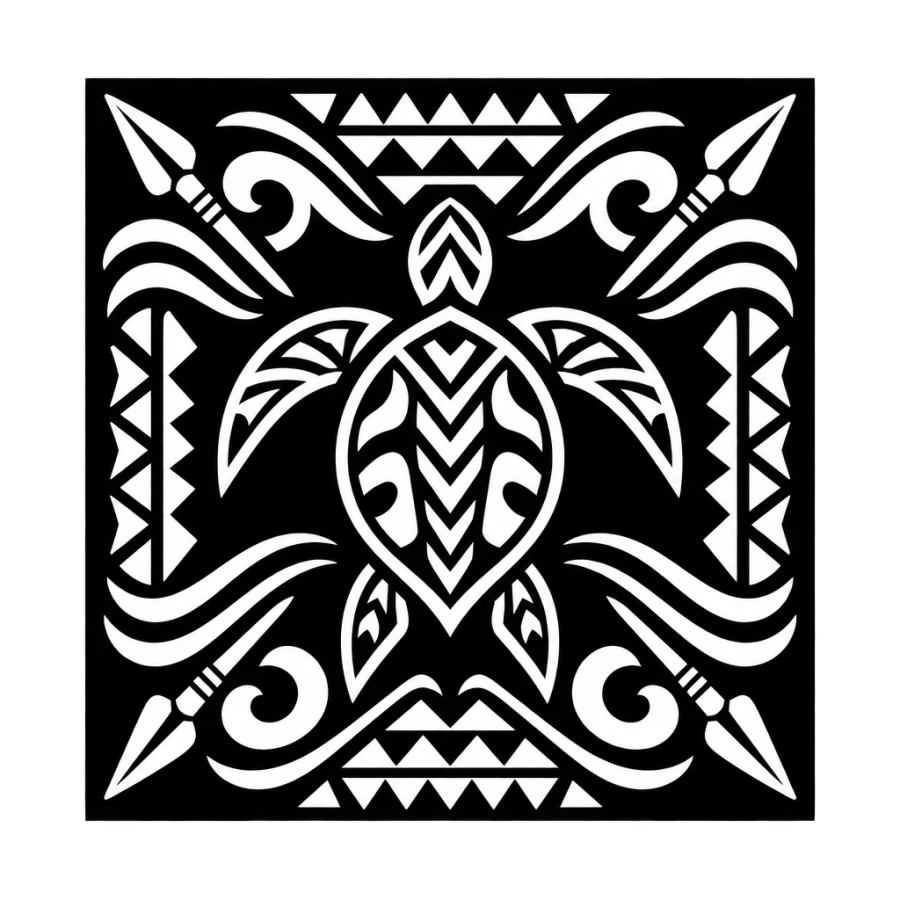
A solid black panel with Polynesian pattern carved out in white
Use this prompt
A Polynesian pattern column in thin open outlines, light and airy
Use this prompt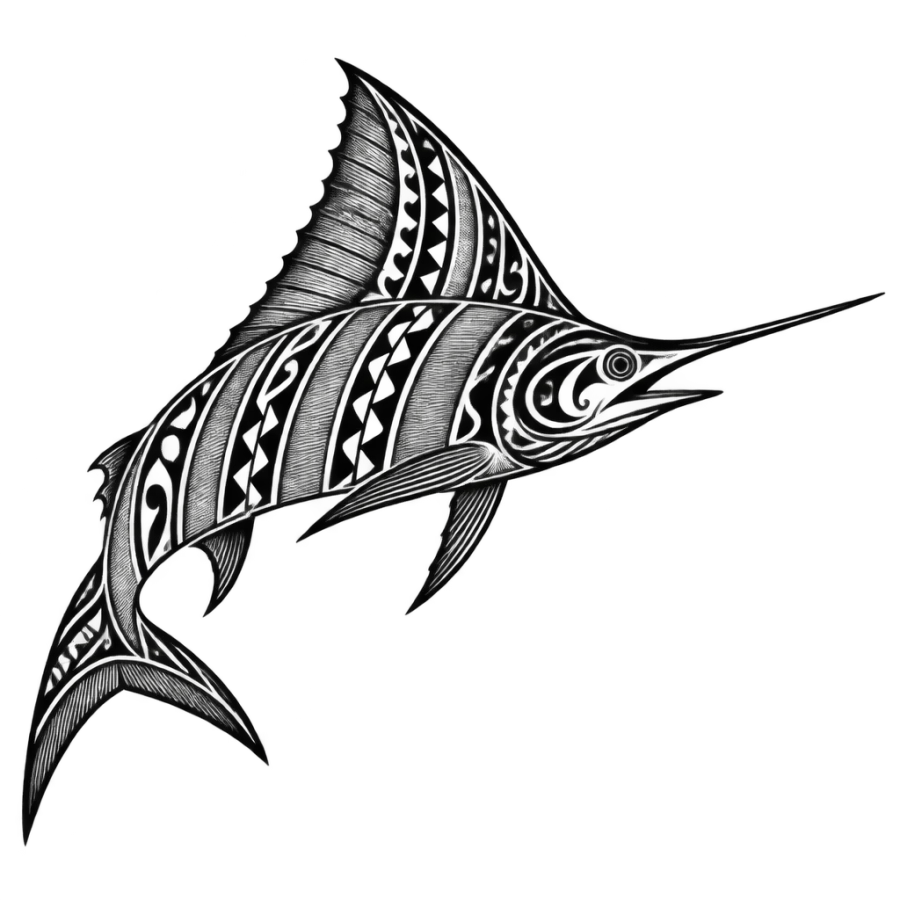
A marlin with its body built from Polynesian motif bands and hatching
Use this prompt
Two mirrored tiki guardian faces with a motif band between them
Use this prompt
A crescent chest band of packed black pattern with a white gap
Use this promptDescribe an idea of your own and get four designs back in about 20 seconds.
Open the generator
Questions people ask
Can I get a Polynesian tattoo if I am not Polynesian?
For a decorative piece, many Polynesian artists will work with you and place motifs they consider appropriate. Taking a genealogical design, a pe'a, a malu or a tā moko without that lineage and that community relationship is disrespectful. The route that works is asking an artist from the tradition and accepting their answer.
What is the difference between tā moko and kirituhi?
TÄ moko is MÄori tattooing that records whakapapa, the wearer’s genealogy, and it belongs to MÄori people. Kirituhi is the term for MÄori styled work created for people outside that lineage. The distinction exists because one carries identity and ancestry and the other is design made in a similar visual language.
Do Polynesian tattoo symbols have fixed meanings?
The general vocabulary is documented: shark teeth for protection, waves for the ocean and travel, enata figures for people and ancestors. The arrangement is where the real meaning sits, and it varies by island and by family. The same shape can read differently in Samoa, Tonga and the Marquesas.
How painful is a traditional hand tapped tatau?
Considerably more than machine work, and the sessions are long. A pe'a is applied over days or weeks by a tufuga with a team stretching the skin, and the pain is understood as part of what the wearer is committing to. Machine made Polynesian style work is closer to 7 out of 10.
How much does a Polynesian style sleeve cost?
A machine made half sleeve of solid black work takes ten to sixteen hours and runs $1,000 to $2,500. A leg piece from hip to knee reaches $2,500 to $6,000 across several sittings. Traditional hand tapped work is arranged through a practitioner and family rather than priced by the hour.