Tattoo styles explained: a tour of 12 styles
Twelve styles, what each one is actually doing with needles and ink, who it suits, and how it looks after ten years on skin.
The short version
- Bold outlines and solid black age best. Low contrast and hair thin lines age worst.
- Find an artist who specializes in your style rather than asking a generalist to attempt it.
- Realism and Japanese work cost the most per piece because both need size and hours.
- Mixing two styles in one piece works only when one clearly leads and the other supports.
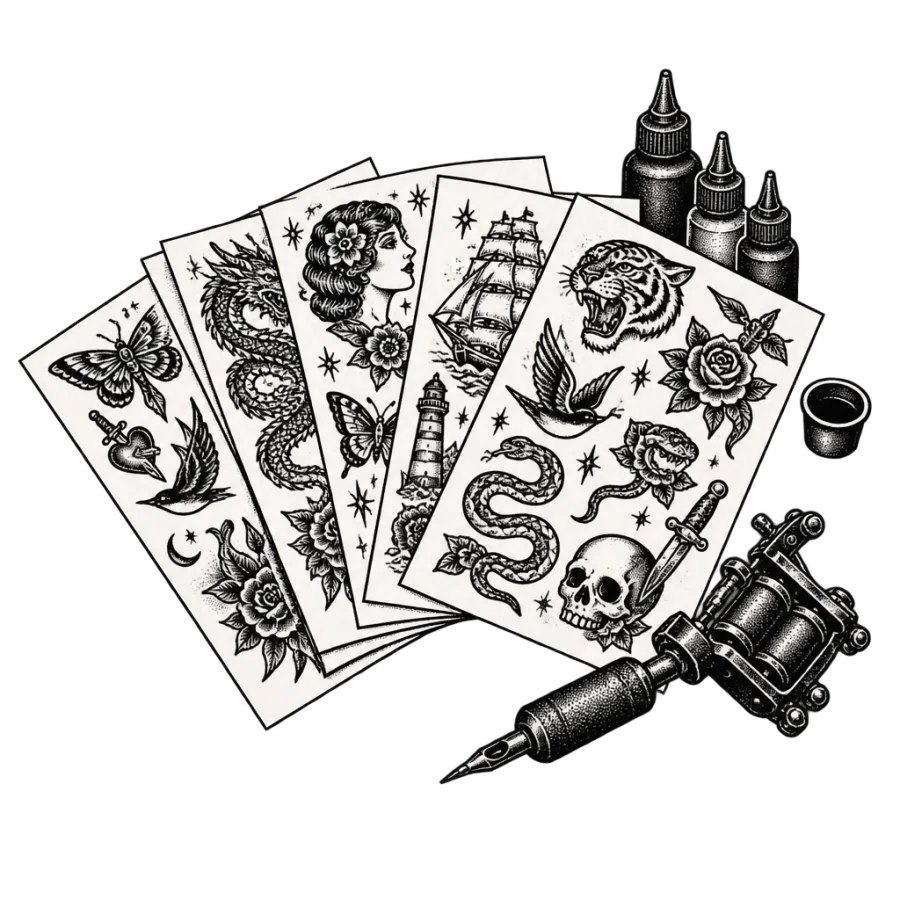
A tattoo style is not a mood or a filter. It is a set of technical decisions: how many needles are grouped together, how heavy the outline is, whether black is packed solid or built in dots, and how much contrast the artist leaves for the skin to eat over the years. Those decisions are why one style still reads at 20 years and another does not.
Picking a style matters more than picking a subject. A wolf can be traditional, realistic, geometric or ornamental, and those are four completely different tattoos with different prices, different artists and different futures. This tour covers all twelve styles on the site, what each is good at, and the mistakes people make combining them.
What actually separates one style from another
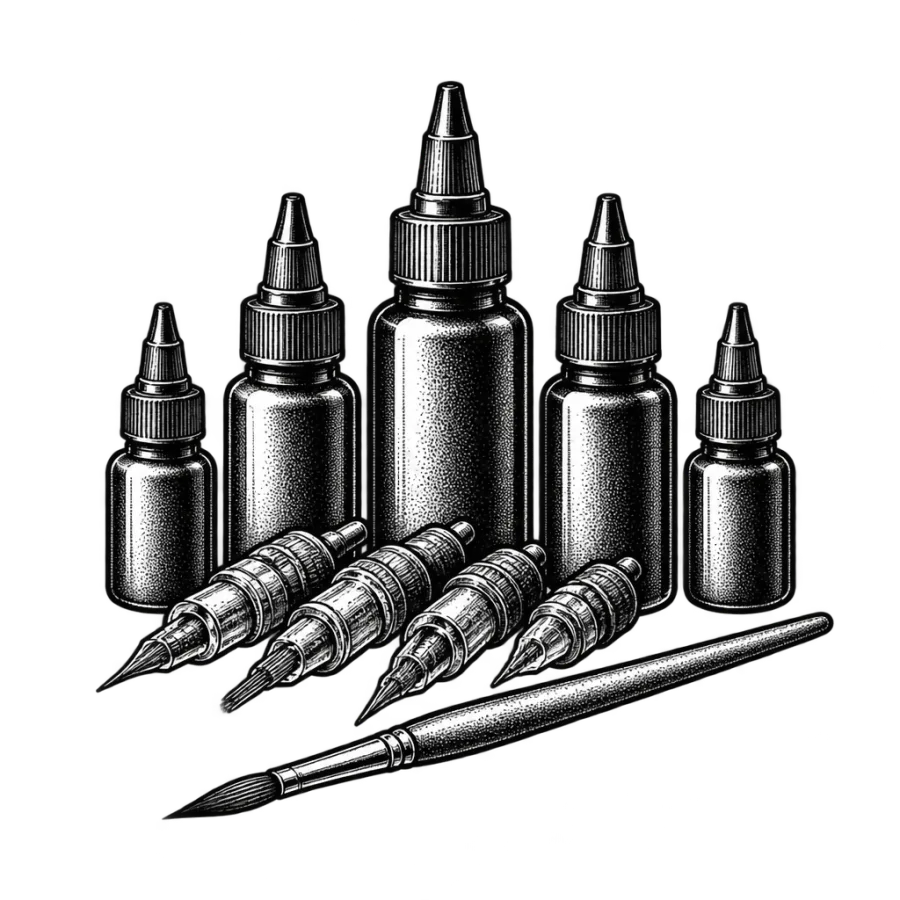
Three variables do most of the work. Needle grouping comes first: a single needle or a 3 round liner draws hair thin lines, while a 9 or 11 liner lays the heavy outline traditional work depends on. Second is saturation, meaning how densely the black or color is packed into the skin. Third is contrast, the gap between the darkest and lightest values in the piece.
Skin is a living filter that keeps softening whatever sits under it. Every line spreads slightly over ten years, every light grey lifts toward invisible, and every color shifts. Styles that assume this and build in heavy anchors survive. Styles that depend on subtle gradients and unoutlined edges need touch ups, or they quietly turn into a smudge nobody can read.
The traditional family: American traditional, neo traditional, Japanese irezumi
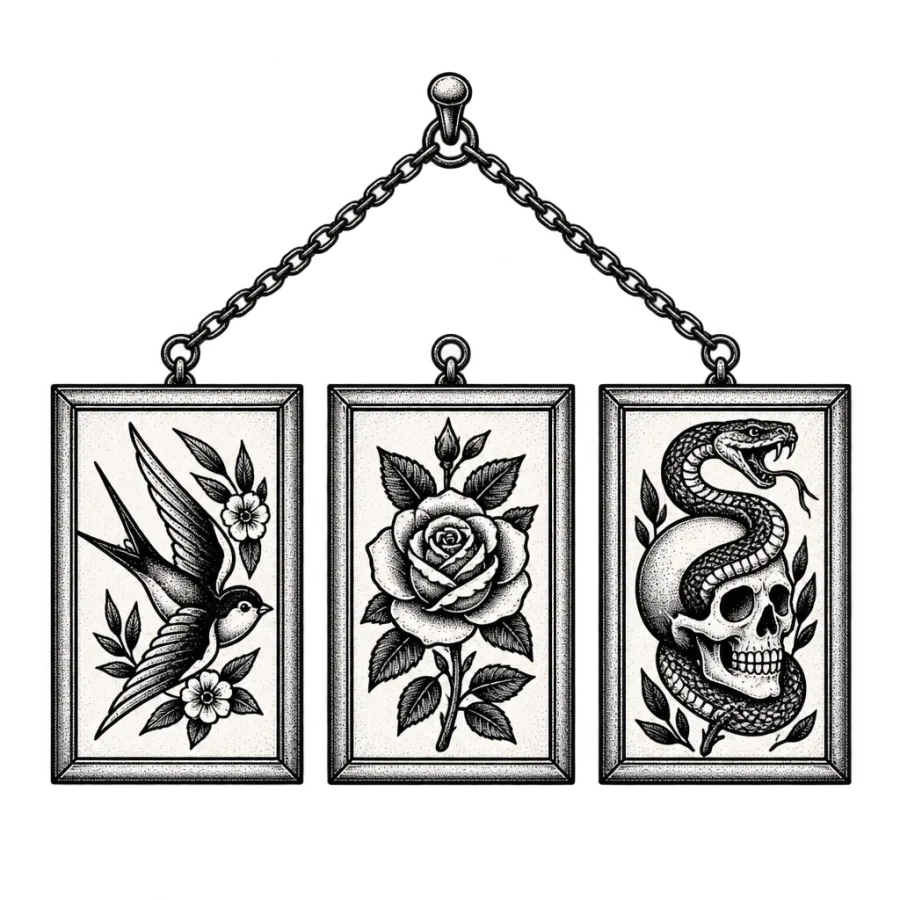
American traditional is the most durable tattooing ever developed. Heavy black outlines, a small flat palette of red, yellow, green and black, and simple iconic subjects: swallows, roses, daggers, panthers. It was built for sailors who would never come back for a touch up, and a well done piece still reads across a room after 30 years. A palm sized piece runs roughly $150 to $350.
Neo traditional keeps the bold outline and adds depth, richer color blends, ornate framing and more naturalistic animals and portraits. It costs more because it takes longer, typically $200 to $600 for a forearm piece. Japanese irezumi is a whole grammar rather than a look: dragons, koi, hannya masks and peonies set into wind bars and wave patterns, designed as a full body flow. Serious Japanese work is priced in day rates of $800 to $1,500 and planned over years.
Black on skin: blackwork, dotwork, ornamental
Blackwork is exactly what it sounds like, solid saturated black used as a shape rather than as an outline. It is the most reliable style for aging and the reason it dominates cover up work. A good blackwork artist thinks hard about negative space, because the untattooed skin inside the design carries as much of the picture as the ink does.
Dotwork builds tone from thousands of individual dots, so shading looks soft and grainy rather than smooth. It is slow, which raises the hourly total, and it needs an artist with genuine patience. Ornamental sits next to both: mandalas, lace, filigree and band patterns that follow the body rather than depicting anything. Ornamental is the strongest choice for wrapping a limb cleanly, since the pattern can stretch or compress to fit.
Quiet and line led: fine line, minimalist
Fine line uses a single needle or a tight 3 round liner to draw thin, even, unshaded or lightly dotted lines. It looks delicate and modern and it is genuinely harder than it appears, because a shaky hand shows immediately and there is no heavy outline to hide behind. It also has the shortest honest lifespan of any style on this list. Expect noticeable softening by year eight and plan on a touch up.
Minimalist overlaps but is about reduction rather than line weight: a mountain in four strokes, a bird in nine. Both styles need flat, protected skin and a floor on size. Below roughly 4 cm, about 1.5 inches, the internal gaps close up as the lines spread. Both are affordable, usually $100 to $250, which is partly why they are the most common first tattoo.
Illusion and pigment: black and grey realism, watercolor
Black and grey realism builds a photographic image out of diluted black washes with no outline at all. It is the most technically demanding style here and the most artist dependent, because the whole effect rests on contrast control. Realism needs size. Under about 15 cm, roughly 6 inches, a face turns to mush. Budget $150 to $250 per hour and several sessions for a portrait.
Watercolor imitates paint on paper: soft bleeds, splashes, color running past the subject. It photographs beautifully and it is the riskiest style for aging, since the pale washes that make it work are exactly what skin lightens first. The honest version pairs the color with a real black structure underneath, a line drawing or a dark anchor, so something still holds the picture together at year ten.

Structure and text: geometric, lettering
Geometric work is built from precise repeated shapes: sacred geometry, polygonal animals, grids and symmetry. Its strength is also its weak point, because the eye catches an error in a straight line or a repeating pattern instantly. Geometric also punishes stretchy placements. Put it on a forearm, calf or upper back rather than a stomach or an inner upper arm.
Lettering is its own craft and the one people underestimate most. Script, blackletter, typewriter and hand drawn type each need a different feel for spacing and weight. Two rules matter more than the font choice: proofread the text three times with someone else reading it aloud, and give the letters room. Small text with tight counters, the enclosed gaps inside letters like a and e, fills in and becomes unreadable faster than any other kind of tattoo.

How the twelve styles age
If a tattoo has to last decades without maintenance, weight the top of this table heavily. If you are happy to sit for a touch up every five or six years, the bottom half is open to you. None of these ratings are about quality. A superb fine line piece and a mediocre traditional one age exactly as their styles predict, because skin does not care how good the drawing was.
| Style | Ages | What changes first |
|---|---|---|
| American traditional | Excellent | Color dulls slightly, lines hold |
| Blackwork | Excellent | Edges soften a little |
| Japanese irezumi | Excellent | Background wash lightens |
| Ornamental | Very good | Fine filler lines thicken |
| Neo traditional | Very good | Light color blends flatten |
| Geometric | Good | Thin connecting lines spread |
| Lettering | Good | Counters in small text fill in |
| Dotwork | Good | Light dot fields merge into grey |
| Black and grey realism | Fair | Mid greys lift, contrast drops |
| Minimalist | Fair | Lines widen, gaps close |
| Fine line | Fair | Softens noticeably by year eight |
| Watercolor | Poor without black | Pale washes go first |
How people combine styles badly
The common failure is treating a sleeve as a collection. Four favorite ideas in four styles, added a year apart, with no shared background or line weight, reads as clutter no matter how good each piece is on its own. If you want variety, pick one dominant style and let the others appear as small supporting details inside it.
The second failure is mixing opposite line weights side by side. Hair thin fine line next to heavy traditional black makes the delicate piece look accidental. The third is putting watercolor splashes behind a black and grey realism subject, which flattens the illusion the realism was built on. A single style done well beats two done politely.
If you already own pieces in different styles, an artist can still tie them together with connective work: a consistent background, a shared black density, filler that moves the eye between them. Raise that at the consultation rather than after the next piece is already on you. Good artists plan a limb two or three tattoos ahead, and it costs nothing to ask for that plan on your first visit.
Questions people ask
Which tattoo style lasts the longest?
American traditional, blackwork and Japanese irezumi. All three use heavy outlines and saturated black, so even after the skin softens every line, the shapes still read clearly. Pieces from the 1970s in these styles are still legible today. Styles that rely on pale washes or hair thin lines need touch ups to stay sharp.
What is the difference between fine line and minimalist tattoos?
Fine line describes the technique, thin even lines drawn with a single needle or a tight liner. Minimalist describes the design approach, stripping a subject down to as few marks as possible. Most minimalist tattoos are drawn fine line, but a minimalist design can also be done in bold heavy strokes, and plenty of fine line work is detailed rather than simple.
Is watercolor a bad idea?
Not bad, just higher maintenance. The pale washes that give it its charm are the first thing skin lightens, so a pure watercolor piece can look weak within five to eight years. The durable version keeps a real black structure underneath, a line drawing or a dark anchor shape, with color spilling around it. Ask to see the artist’s healed photos at three years or more.
Can one artist do every style?
Almost nobody does. Most artists genuinely excel at two or three related styles and are merely competent at the rest. Look at their portfolio and count how many pieces match what you want. If your style appears once in fifty posts, keep looking. Booking a specialist usually costs about the same and produces a much better tattoo.
How do I know which style suits me?
Work backwards from three things: how long you want it to look sharp without maintenance, how much space you will give it, and your budget. Then look at healed photos rather than fresh ones, since fresh work flatters every style equally. Save twenty tattoos you like and check what they share. That pattern is usually your answer.